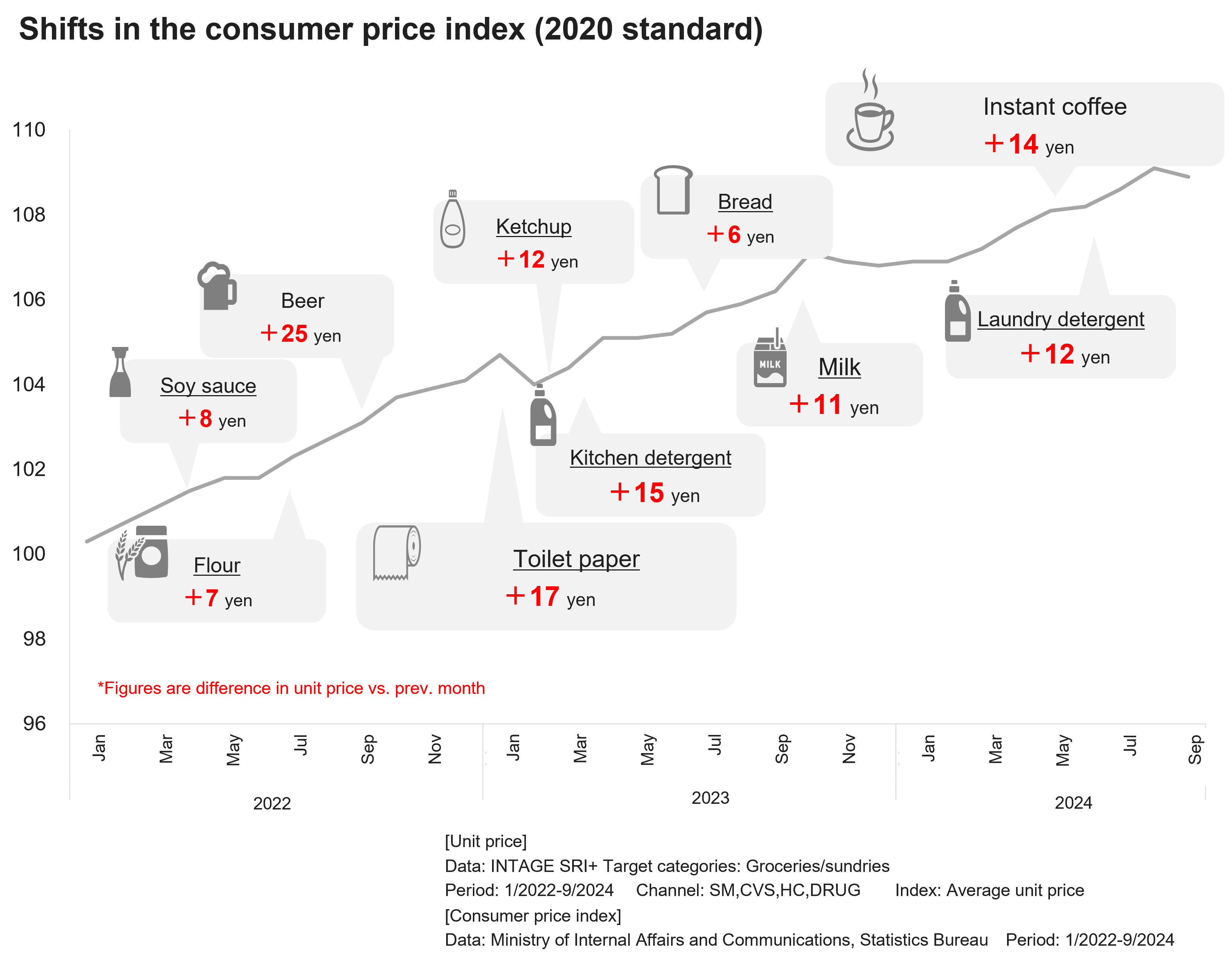
Driven by a weak yen and rising resource prices, there has been an ongoing rush to increase prices since 2022. Price hikes are being implemented not only with food products and daily sundries, but also for a variety of other goods and services as well. The consumer price index announced by the Ministry of Internal Affairs and Communications has been rising steadily, and as of September 2024, was+8.9% against the 2020 standard, indicating that consumers’ household budgets are being dealt a major blow (Fig.1). How have consumers dealt with these price hikes, which have increased their consciousness of economizing, over close to the past 3 years? Let’s analyze the changes in purchasing behavior from purchasing data for the past 3 years.
Fig.1
2. Classifying consumers based on their values regarding shopping
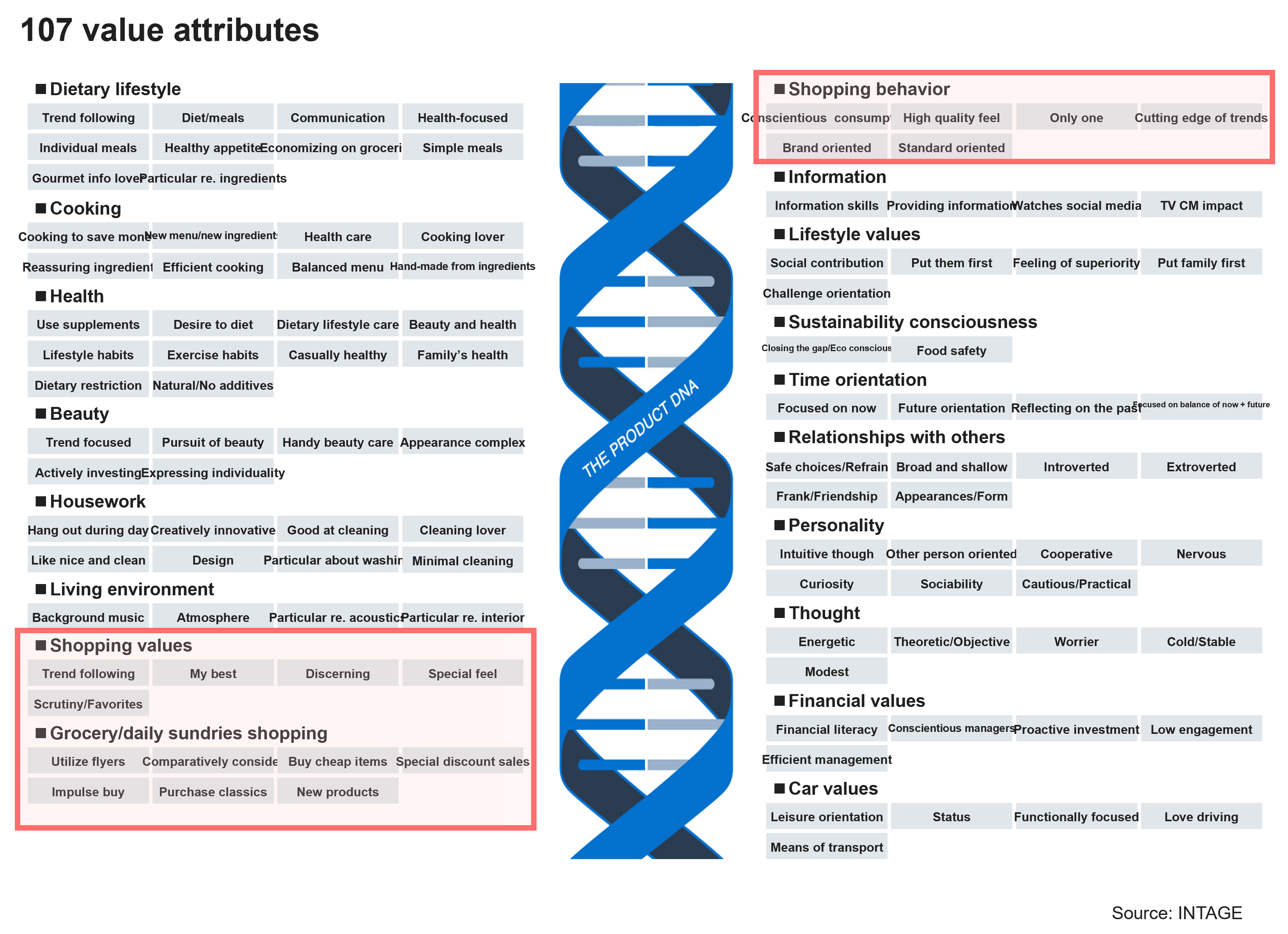
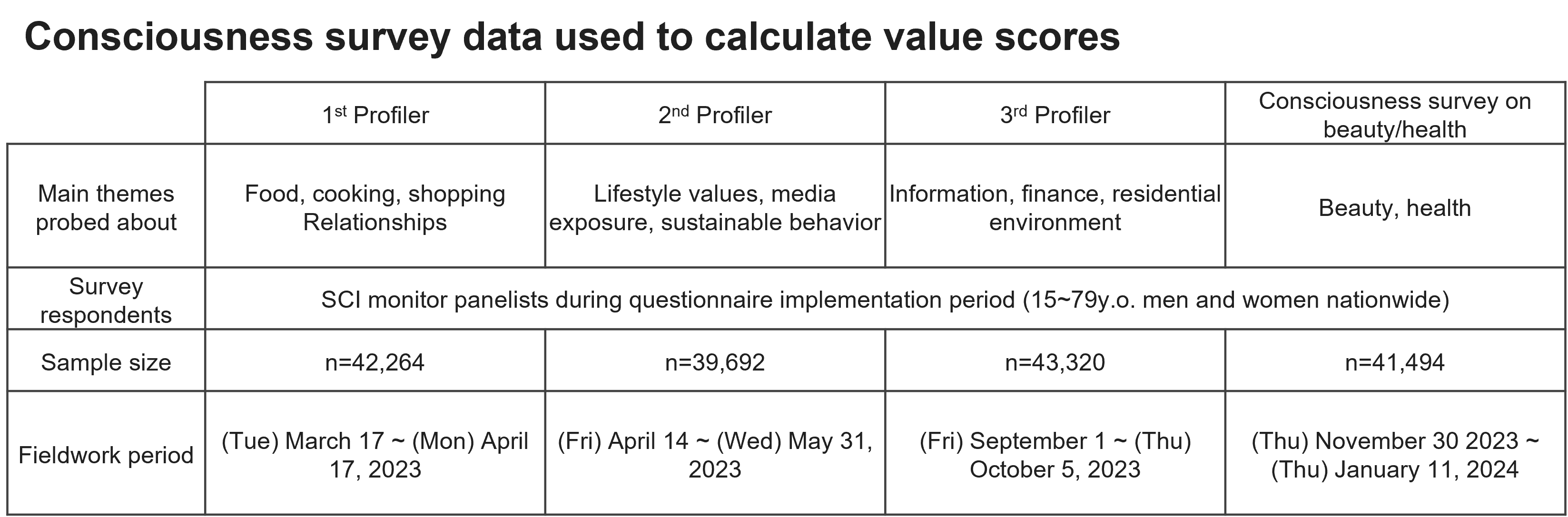
Amidst these ongoing price hikes, attention tends to be focused on changing purchasing behavior such as refraining from purchasing and economizing, while at the same time, it seems that some consumers are not that concerned about these price hikes, and are continuing to engaging in purchasing behavior as usual. In this article, we will analyze changes in purchasing behavior using SCI® (Nationwide Consumer Panel Survey), daily shopping data from over 50,000 consumers nationwide. In order to capture the differences in impact price hikes have on purchasing behavior, we classified consumers according to their values regarding shopping from unique value scores from 107 attributes created based on a consciousness survey (Profiler) (Fig.2), and conducted analysis focusing on two distinctive types within our results.
Fig.2
The first type are “cautious purchasers”, and are consumers characterized by considering the necessity of things before shopping, carefully comparatively considers items before making a decision when buying products, and buying the things they want after saving the money for them. We consider that this type of consumer probably changes their purchasing behavior in order to economize. The other type are “intuitive purchasers”, and are characterized by buying things they haven’t planned for, impulse buying things because of eye-catching displays, packaging, and naming. We envisage that this type does not place that much focus on economizing, so have not changed their purchasing behavior much before and after the price hikes.
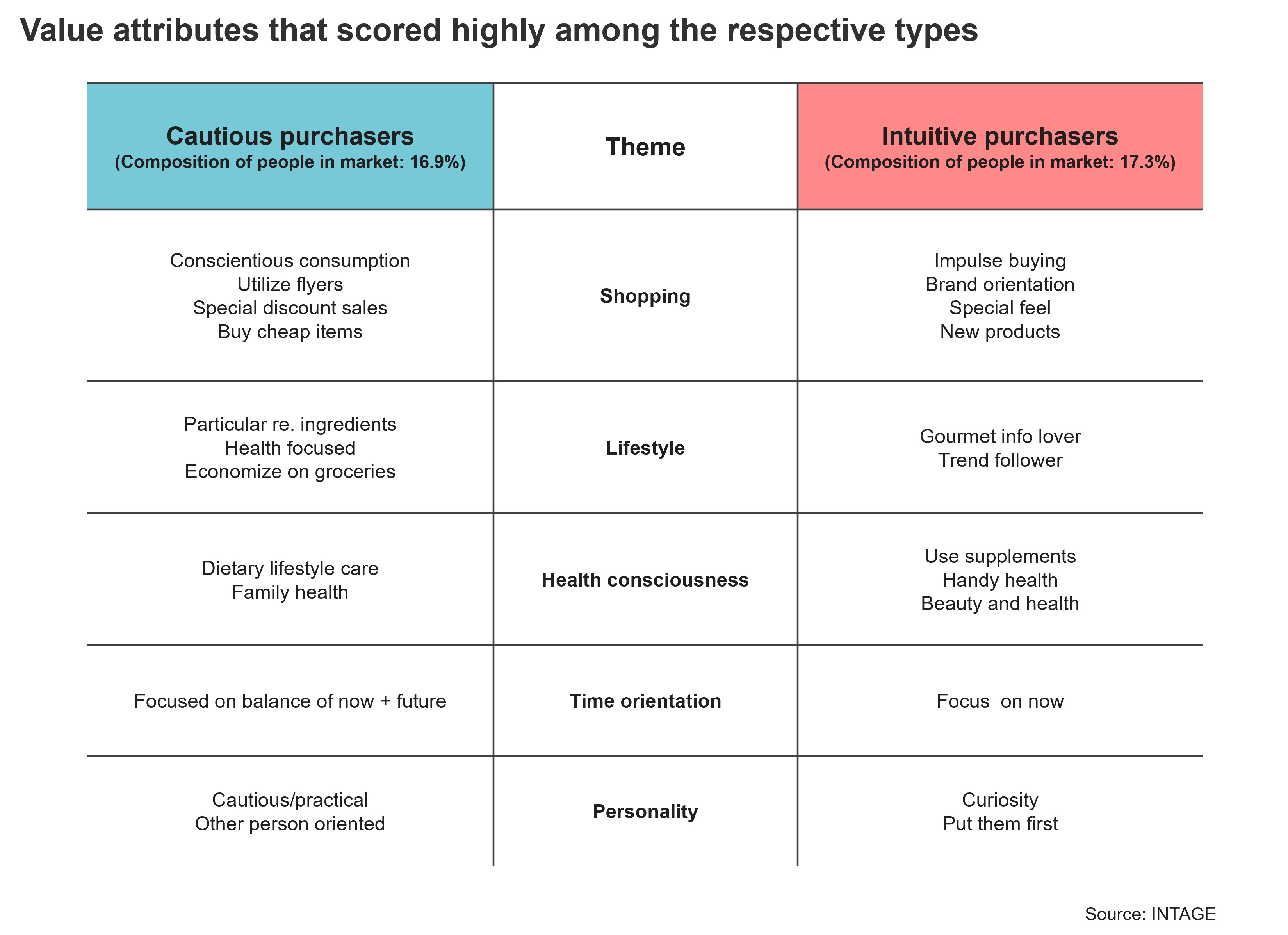
Let’s paint a more detailed picture of the profiles of both types of consumers based on their value scores from the 107 attributes mentioned above. Fig.3 illustrates the value attributes that score highly among both of these types.
Fig.3
Cautious purchaser consumers are not only characterized by price-oriented values such as “Using flyers, special sales, and purchasing cheap items”, but also keywords such as “family health”. This makes it apparent that this type of consumer has a family, manages their family’s purse strings, and makes purchases for their family rather than for themselves. In addition, they are the type of people with a “cautious, realistic” orientation, characterized by a “focus on the balance between the present and the future”, and thus want to be fulfilled not only now, but in future as well, so are deemed to prefer to choose lower-risk behavior and engage in sound and steady purchasing behavior.
On the other hand, intuitive purchaser consumers are characterized by keywords such as “impulse buying, a special feeling, and new products”, and it is apparent they are people who have an eye for trending and popular things. They are the type of people with a “curious” and “focus on the present” orientation, so are surmised to, in contrast with cautious purchasers, to focus on being fulfilled in the present, with this leading to their intuitive, impulsive purchasing behavior.
3.How has purchasing behavior changed due to the price hikes?
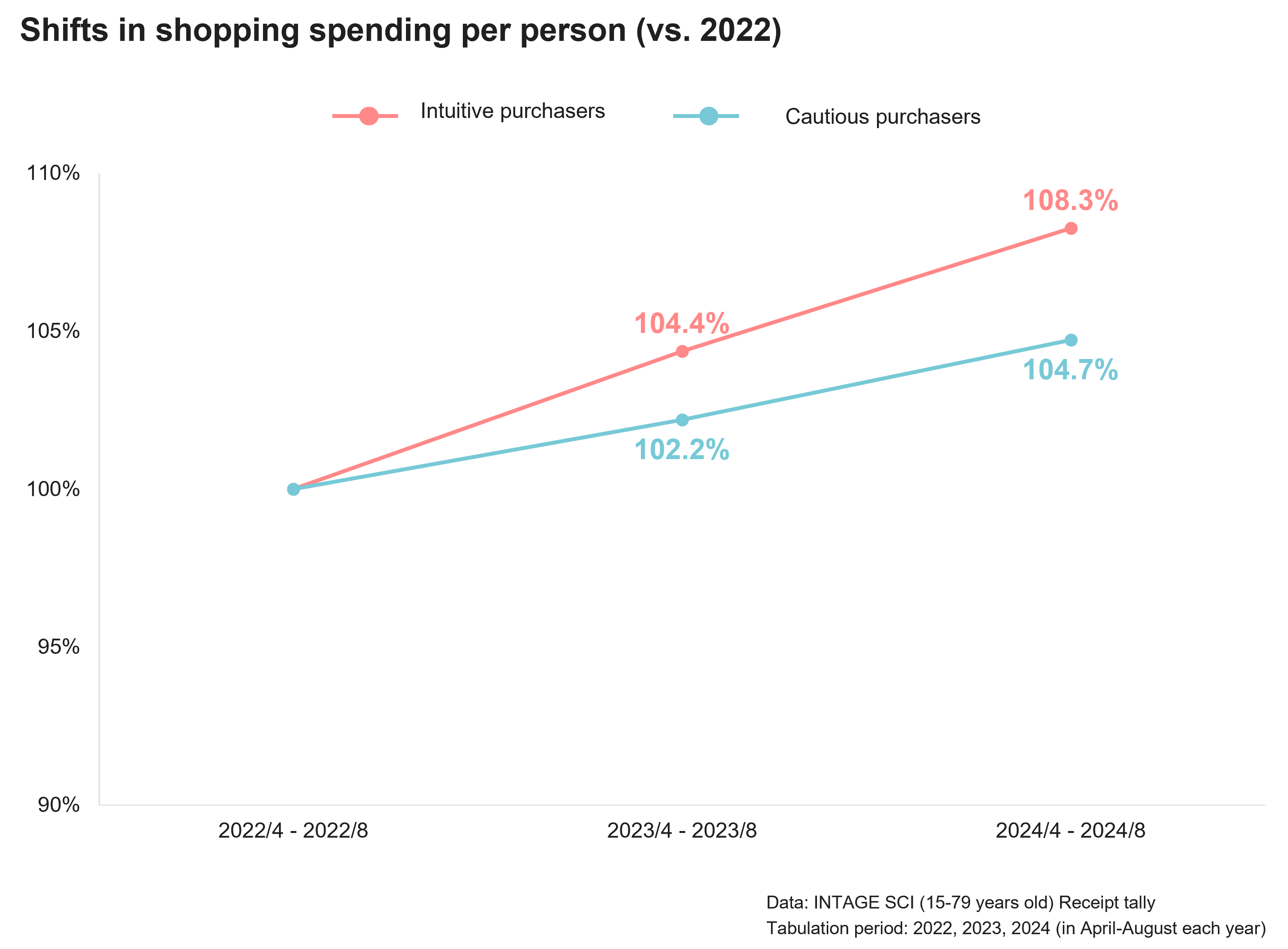
Next, let’s take a look at the changes in purchasing behavior by these two types during the rush to increase prices. Fig.4 depicts shifts in shopping spending per person with April to August 2022 as the baseline. As expected, intuitive purchasers increased their shopping spending, although cautious purchasers also increased their shopping spending, suggesting they have been unable to go against the flow with these waves of price hikes.
Fig.4
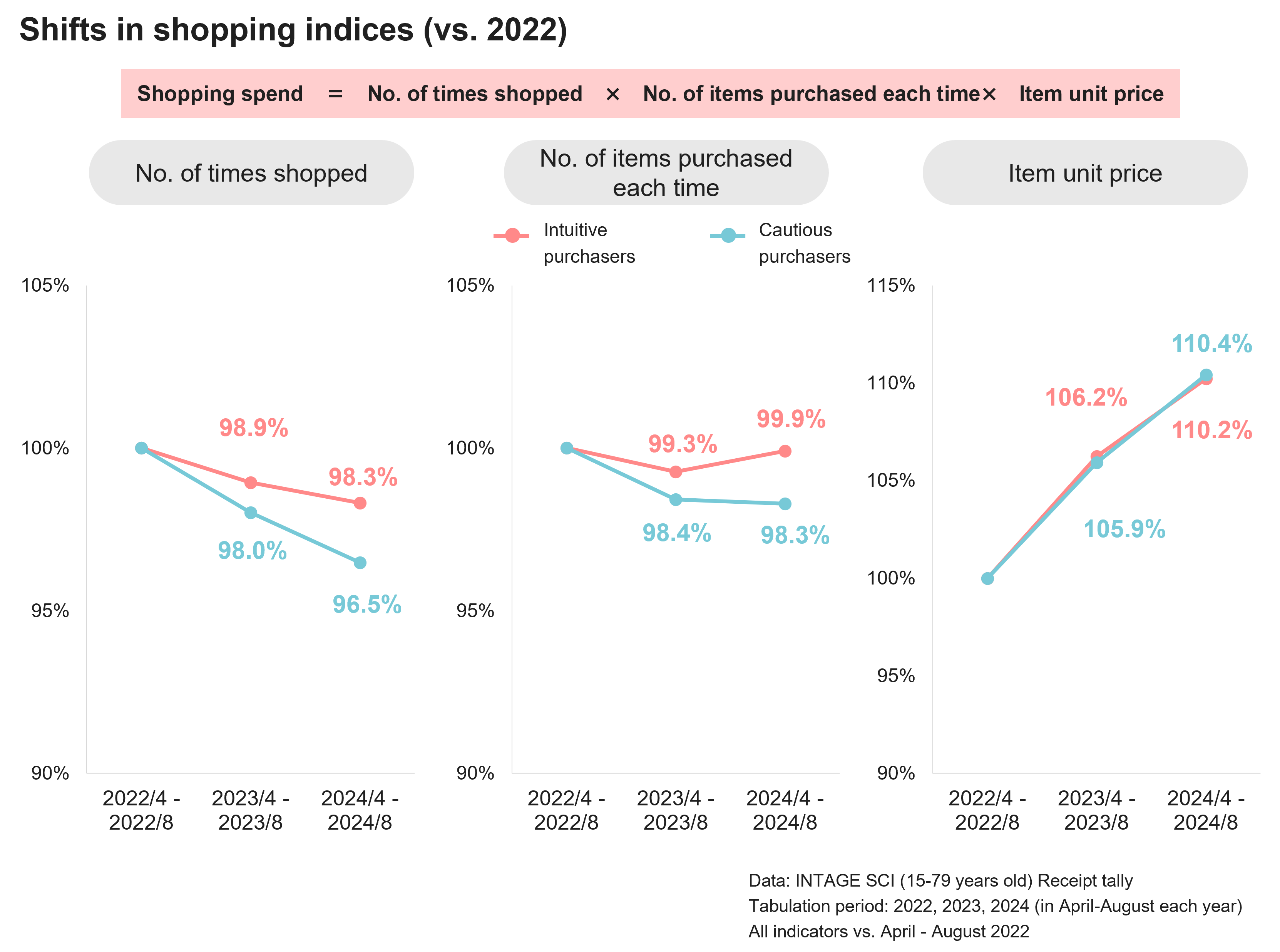
Fig.5 shows the breakdown of shopping spending according to 3 indices. On observation of these results, it is clear that cautious purchasers are trying to economize by cutting down the number of items they purchase each time they shop as well as on the number of times they shop compared to intuitive purchasers.
Fig.5
As prices continue to rise, they may be becoming more severe with their choices, and be striving to engage in less impulse buying than to date (by limiting the number of items they buy), and stocking up in bulk on days when they can earn more points or benefit from a higher discount rate (by limiting the number of times they shop). At the same time, upon focusing on the index of individual unit price, both types show similar rates of increase, indicating that it is difficult to economize by attempting to keep down the unit prices of what one buys amidst price hikes.
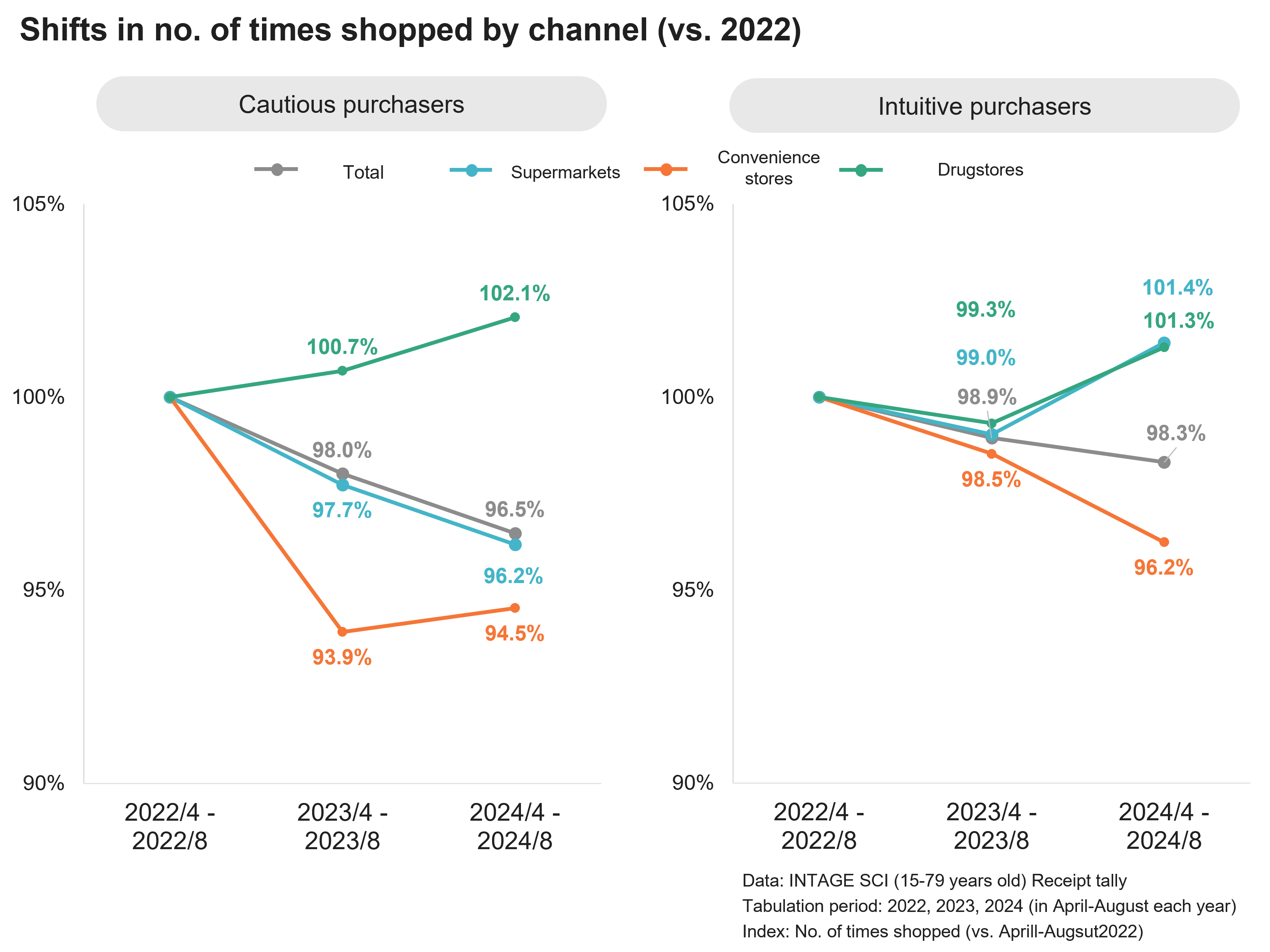
Let’s examine the data on changes in number of times consumers shop, with a focus on the business channel. Fig.6 depicts changes in the number of times consumers shop by business channel purchased at. The number of times both types shop at convenience stores has decreased. Convenience store firms have recently been running campaigns offering great deals, but may still have an image of being more expensive than other business channels.
Fig.6
It is also interesting to note that cautious purchasers, who are cutting down on the number of times they shop, have increased the number of times they shop in drugstores alone. There are two possible factors behind this. One is that groceries can be purchased cheaply at drugstores. The number of drugstores putting an emphasis on groceries has increased in recent years, with the same products sometimes being sold cheaper there than at supermarkets. As prices continue to rise and people search for cheaper stores, they seem to be starting to purchase the items they have bought from supermarket to date at drugstores. In reality, on observation of the channels cautious purchasers buy groceries at, the data confirmed an influx from supermarkets to drugstores. In addition, on focusing more specifically on what they are purchasing at drugstores, their purchases of daily necessities (such as milk and tofu) and beverages (such as tea and coffee beverages) have increased.
The other factor behind this is the impact of Covid-19 shifting to a class 5 infection in May 2023. Prior to its shift to class 5, wearing masks was left to the discretion of the individual in March 2023, and opportunities to go out unmasked increased. Since cautious purchasers tend to shop with what they need in mind, they cut down on purchases on cosmetics when wearing masks in 2022, and sizably increased in their purchases of cosmetics when they stopped wearing masks, with this driving the increase in their use of drugstores as their main place of purchase for cosmetics.
4. Economizing behavior in the purchase of private-label brand products
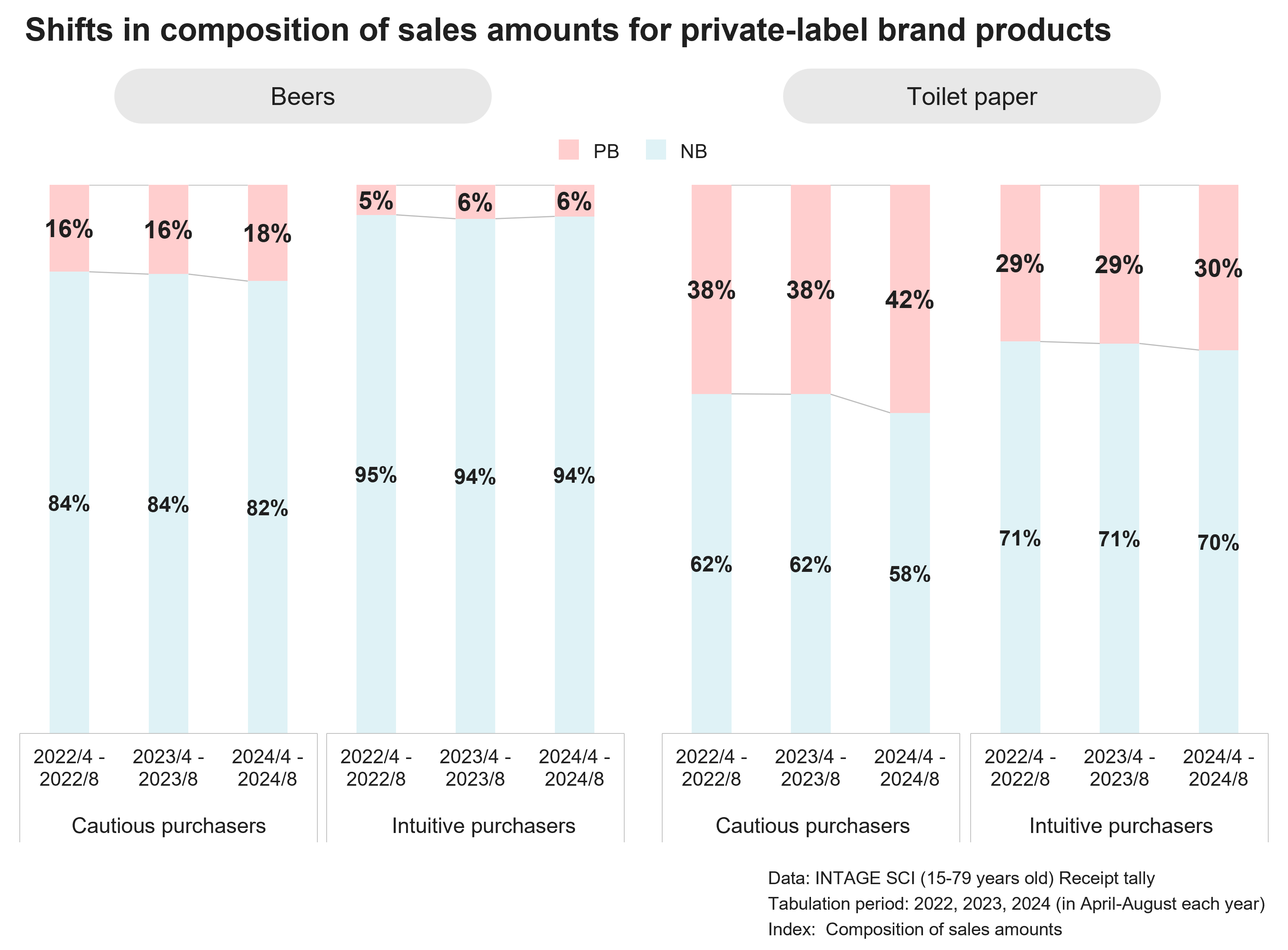
Let’s focus in on the purchase of private-label brand products as one way to economize in response to price hikes. Fig.7 depicts shifts in the composition of sales amounts for private-label brand products with the “beer” and “toilet paper” categories.
Fig.7
Private-label brand products went on to make up a larger proportion of cautious purchaser consumers’ purchases in both categories. Now that price hikes have made it more difficult to shop at lower unit prices, private-label brand products which can be purchased at reasonable prices may be increasingly becoming an ally to household budgets.
5. Conclusion
In this article, we classified consumers by their values regarding shopping, and analyzed changes in purchasing behavior amidst price hikes. While attention is focused on economizing behavior amidst these ongoing price hikes, this analysis clearly shows that there is also a certain proportion of consumers who are continuing to shop as usual, largely unaffected by these price hikes. As we have seen, people react differently to price hikes. Prices are expected to continue to rise going forward, but by communicating appropriately in line with values, it should be possible to improve sales promotion efficiency and prevent customers from lapsing due to these price hikes.
The values data introduced in this analysis was created based on a several-hundred question consciousness survey (Profiler). The results from questionnaire surveys like this are often used when attempting to classify consumers based on their values, although you may be troubled by the complexity of conducting a large-scale questionnaire survey with members of your company even if you want to analyze data from your own company. INTAGE offers a service called Genometrics ® which estimates members’ values solely from sales data like IDPOS without the need for a questionnaire. For details on this service, please see the following link.
Author profile
Yutaka Enomoto, Planning Promotion Department, INTAGE Inc.
Joined INTAGE in 2020. Engaged in data analysis work mainly in the distribution industry.
In charge of the management and development of INTAGE’s “Genometrics” service, providing solutions using consumer value data
Joined INTAGE in 2020. Engaged in data analysis work mainly in the distribution industry.
In charge of the management and development of INTAGE’s “Genometrics” service, providing solutions using consumer value data
Reproduction and Quotation
◆This report is copyrighted by INTAGE Inc. Please check the following prohibitions and precautions, and specify the source when reproducing or quoting this report. “Source: INTAGE “Knowledge Gallery” article published MM/DD/YYYY article”
◆The following are prohibited: ・Alteration of this article in full or in part ・Sale or publication of this article in full or in part ・Uses that are against public order and morality, and uses connected with illegal activities ・Reproducing or quoting panel data* for the purpose of advertising or promoting companies, products, or services *Panel data include: SRI+, SCI, SLI, Kitchen Diary, Car-kit, MAT-kit, Media Gauge, i-SSP, etc.
◆Other precautions: ・INTAGE Inc. shall not be liable for any trouble, loss, or damage caused by the use of this report ・These usage rules do not restrict the use of quotations or other uses permitted under the Copyright Act of Japan
◆For inquiries about reproduction and quotation, click here