SDGs have come of age: how different generations perceive the 17 SDG objectives
INTAGE has been conducting an ongoing independent survey on SDGs since 2020. As the term “SDGs” penetrates Japanese society, to what extent will it impact the selection of products and services? This article will deliver the latest trends based on the findings of our independent survey to date. We will also focus on generational differences and consider how marketing can respond.
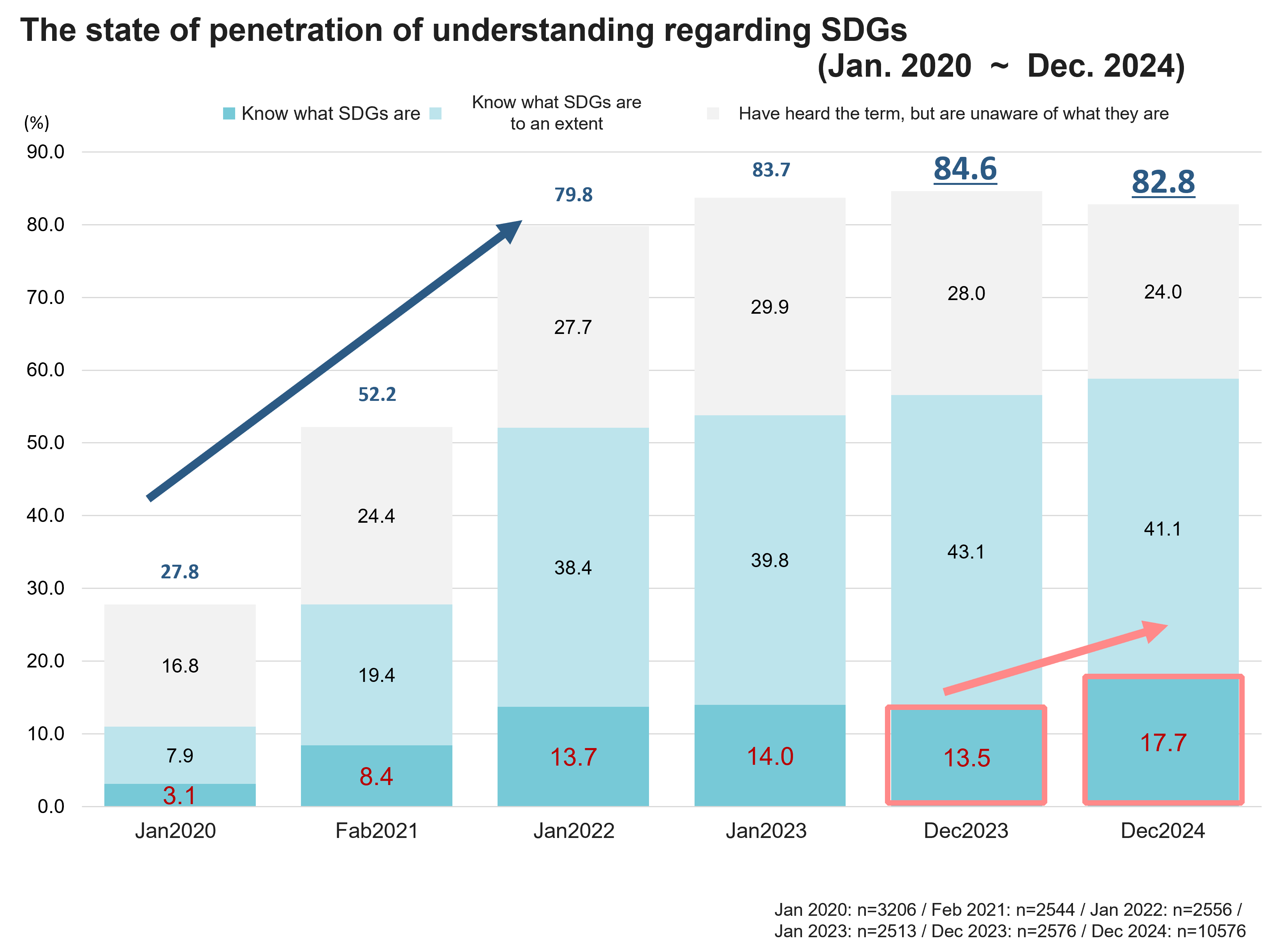
Diagram 1 compares the state of penetration of understanding regarding SDGs chronologically. While the awareness rate* for the word “SDGs” itself increased sizably every year from 2020 to 2022, it was 84.6% in December 2023, and 82.8% most recently (December 2024), a slight decrease, albeit not a sizable change in figures.
Fig.1
At the same time, the number of people who “Know what SDGs are” increased 4.2 points from the previous wave (13.5%) to 17.7%, indicating awareness regarding SDGs is spreading, with those who understand what SDGs are also increasing.
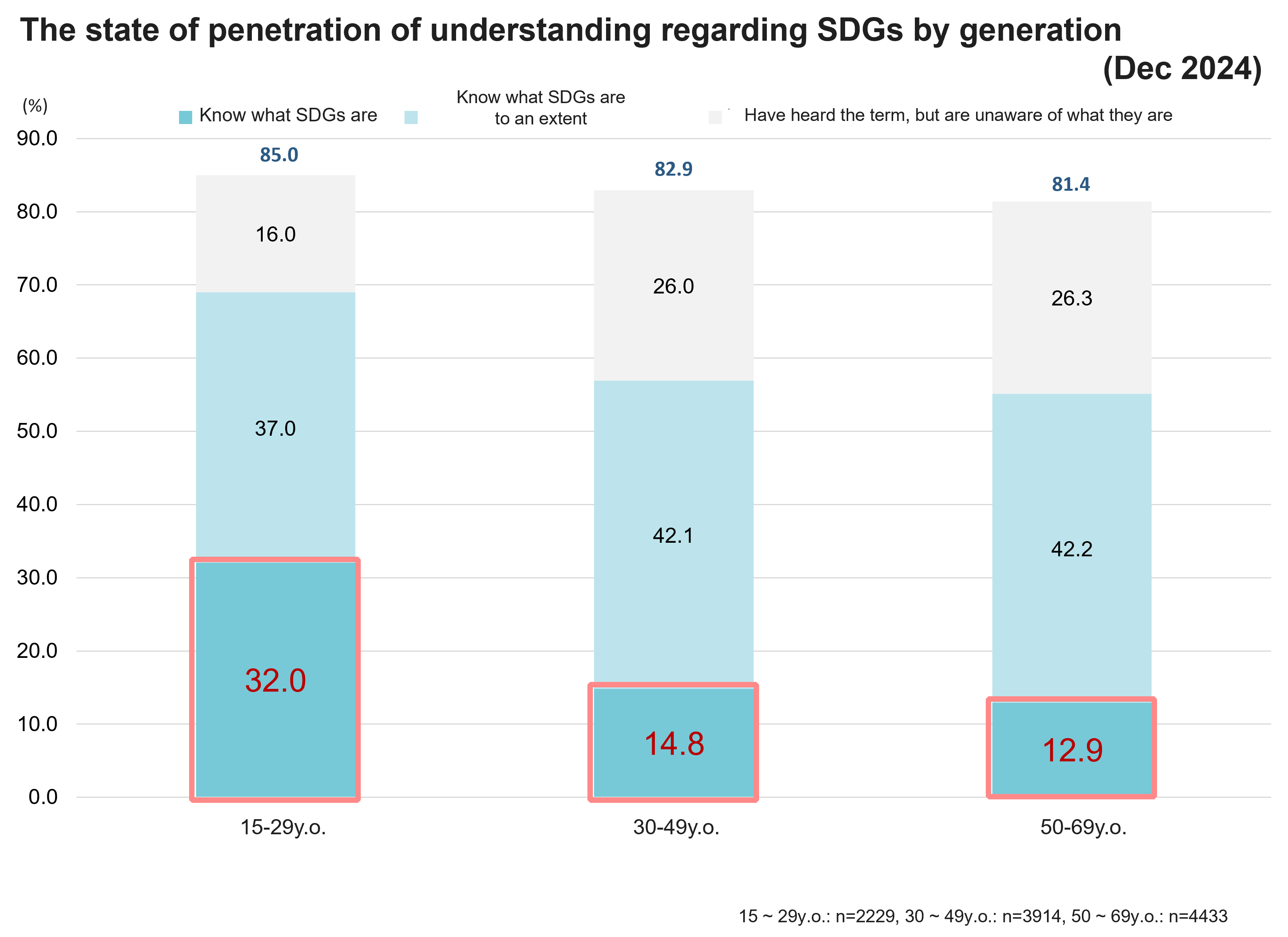
On observation by generation (Fig.2), 32.0% of those aged 15 ~ 29 “Know what SDGs are”, a higher result than other generations influenced in part by school education. Understanding regarding the nature of SDGs is expected to continue to progress in future as well, especially among younger people.
*Awareness rate: The total of those who “Know what SDGs are”, “Know what SDGs are to an extent”, and “Have heard the term, but are unaware of what they are”
Fig.2
2. Are there generational differences in the 17 SDG objectives they prioritize engaging in?
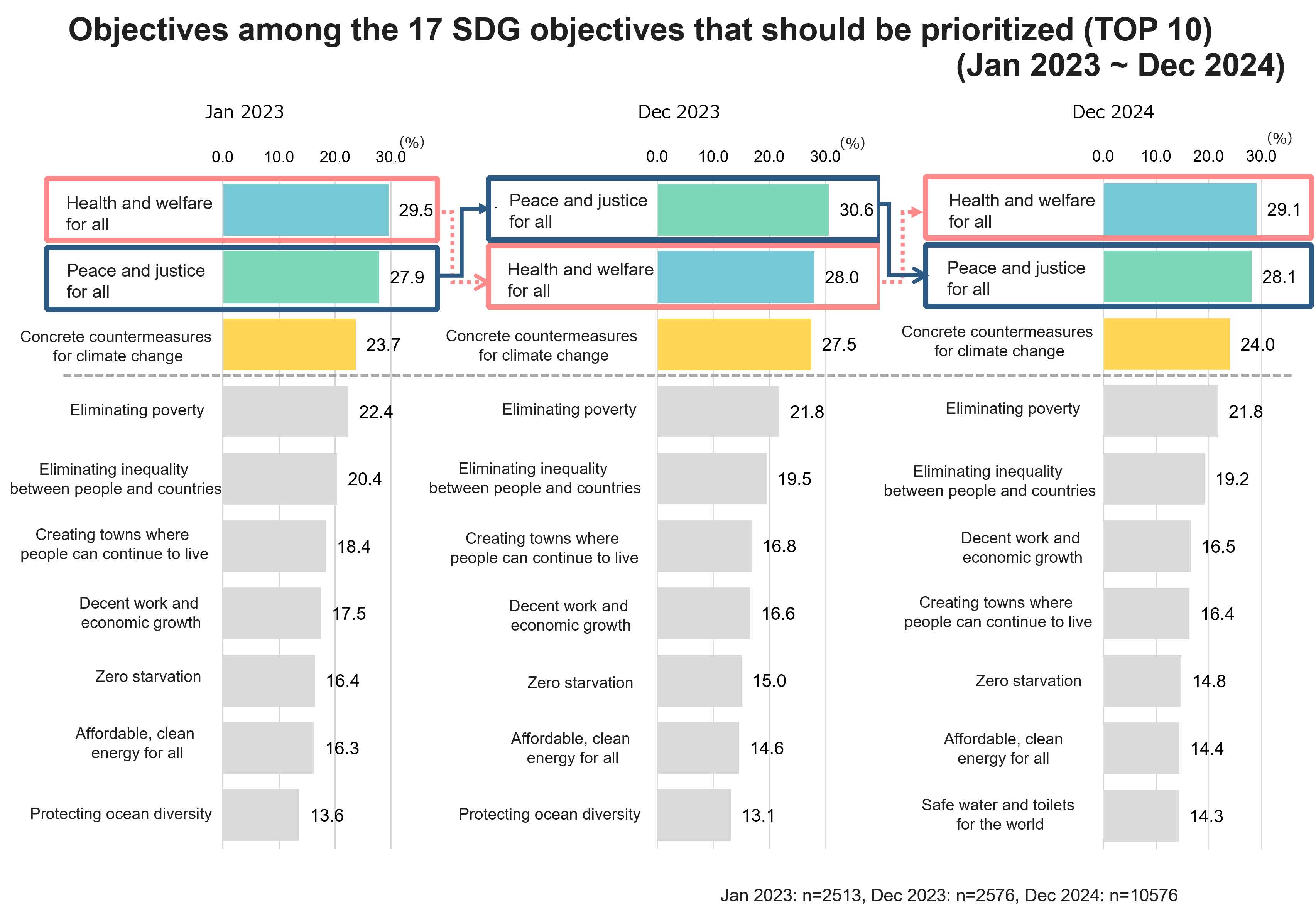
Next, let’s examine how the consciousness of “objectives that should be prioritized with SDGs” has changed over the past 4 years. Fig.3 depicts the results of adding up the three SDGs people chose in the order they thought they should be prioritized in out of 17 SDG objectives, with these them added up.
Fig.3
Due to the invasion of Ukraine and the Gaza Strip conflict, “Peace and justice for all” was top in December 2023, shifting to second in December 2024. On observation of the top 3 over the past 3 years, “Health and welfare for all”, “Peace of justice for all” and “Concrete countermeasures for climate change” were selected consistently, with the ranking of these three objectives appearing to change depending on the social climate.
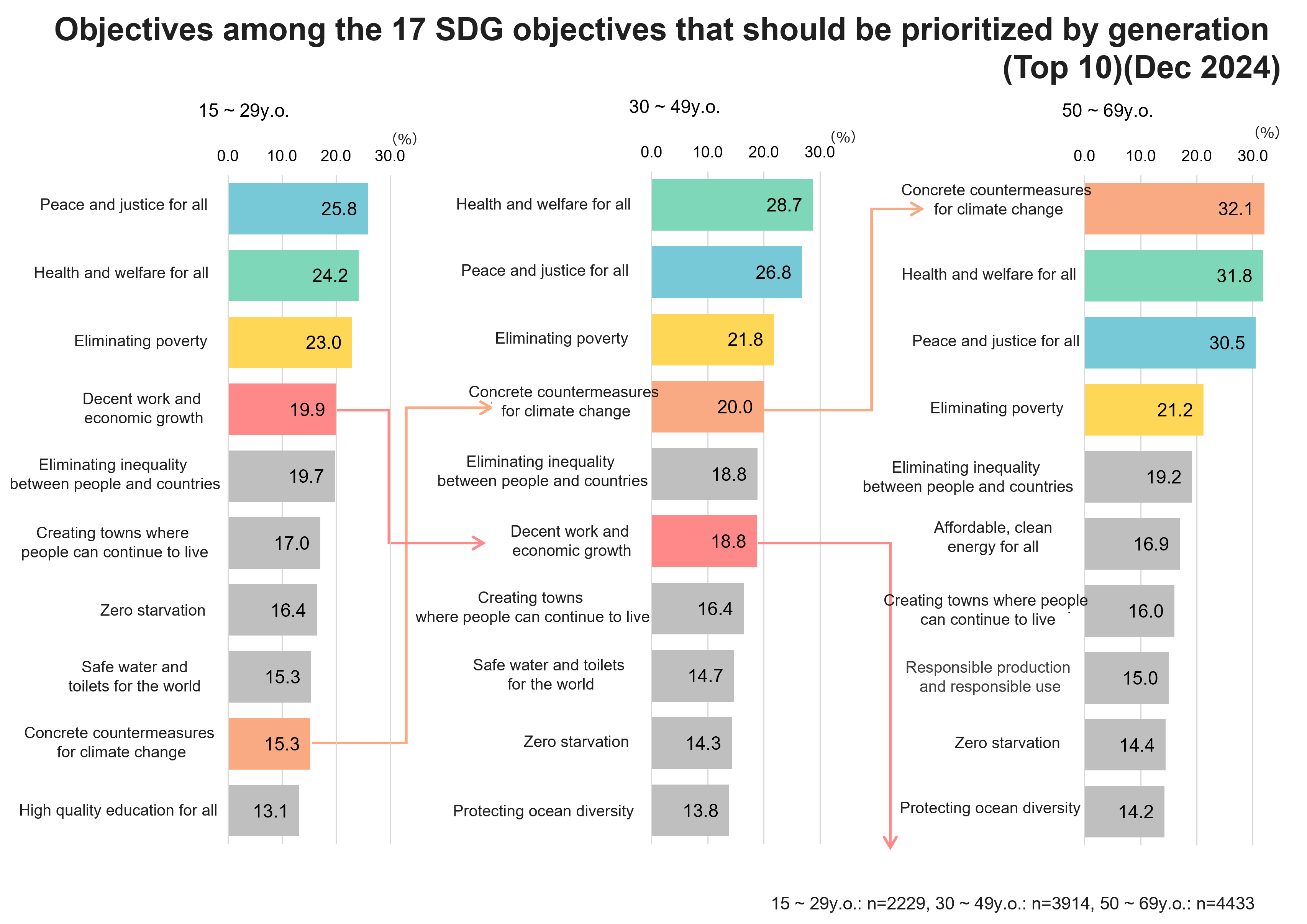
Fig.4 presents the results tabulated by generation of the rankings of these 17 SDG objectives.
“Concrete countermeasures for climate change” ranked higher the older the generation, at 9th place among 15 ~ 29-year-olds, 4th place among 30 ~ 49-year-olds, and at 1st place among 50 ~ 69-year-olds. Conversely, “Decent work and economic growth” ranked lower the older the generation, at 4th place among 15 ~ 29-year-olds, 6th place among 30 ~ 49-year-olds, and 12th place among 50 ~ 69-year-olds. “Decent work and economic growth” ranked highly among younger generations who place importance on their current lifestyle, while the number of people selecting “Concrete countermeasures for climate change” increased among 50 ~ 69-year-olds, who are concerned about their lifestyle in future, as well as the next generation. It is thus apparent that the order each generation feels the 17 SDG objectives should be prioritized for engagement differs based on the background of each generation.
Fig.4
3. Has sustainable behavior increased?
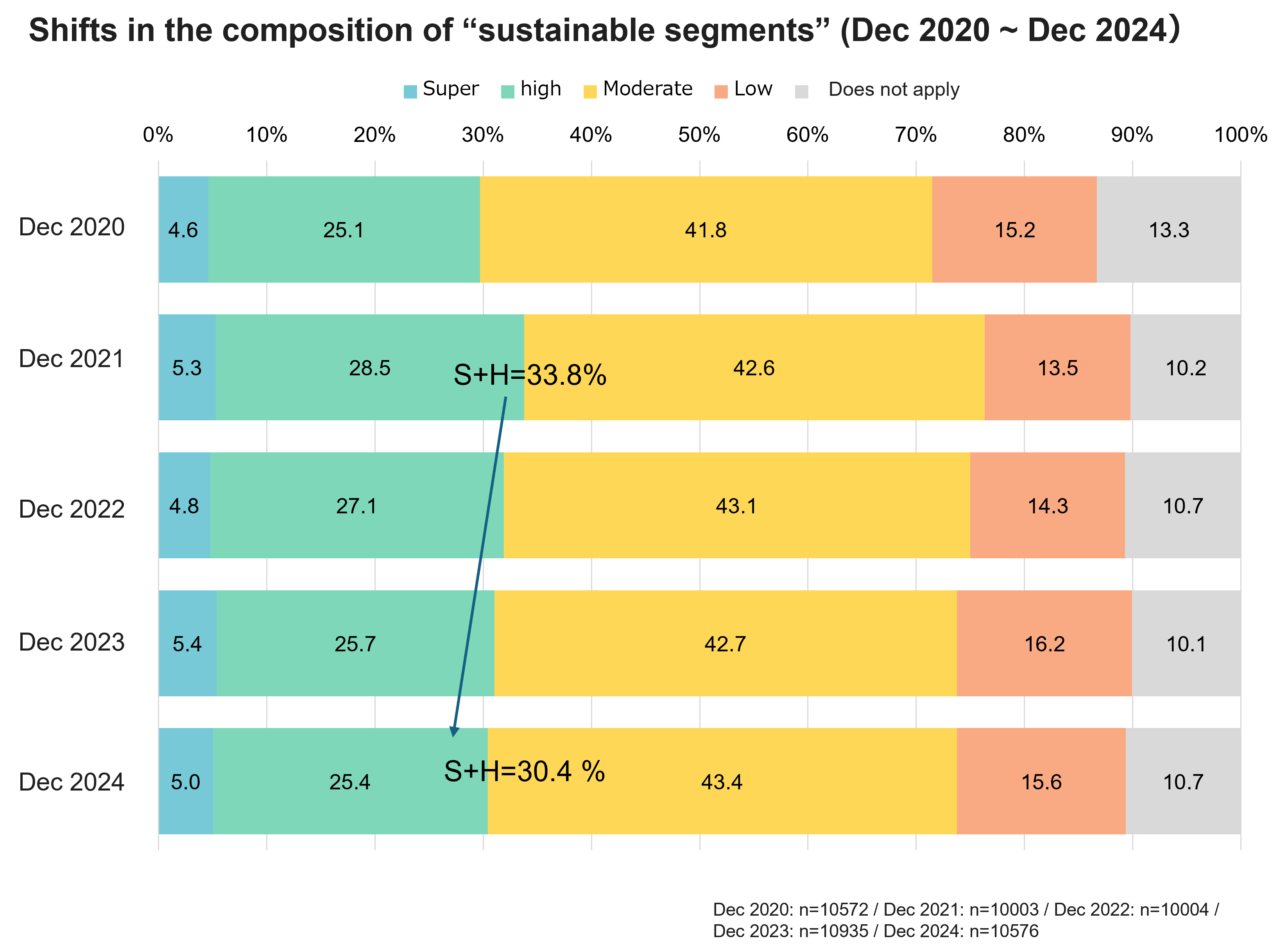
So what sorts of sustainable behavior are consumers engaging in toward the 17 SDG objectives? At INTAGE, we created “sustainable segments” dividing the extent of this behavior into 4 sub-segments from Super (those who are actively engage in sustainable behavior and ask others to cooperate) to Low (those with quite low sustainability consciousness). *For details on these sustainable segments, please refer to “Leveraging a sustainable perspective to solve business issues”. Fig.5 depicts the change in composition ratios of this segment.
Fig.5
Since December 2021, there have been no sizable changes in the composition ratio of the sustainable segments. The Super segment (S) + High segment (H) who actively engage in sustainable behavior accounted for 33.8% in December 2021, but have been on a downward trend since then, and were a low 30.4% in December 2024. This may be due to a gradual decline in the social and environmental consciousness heightened during the covid crisis.
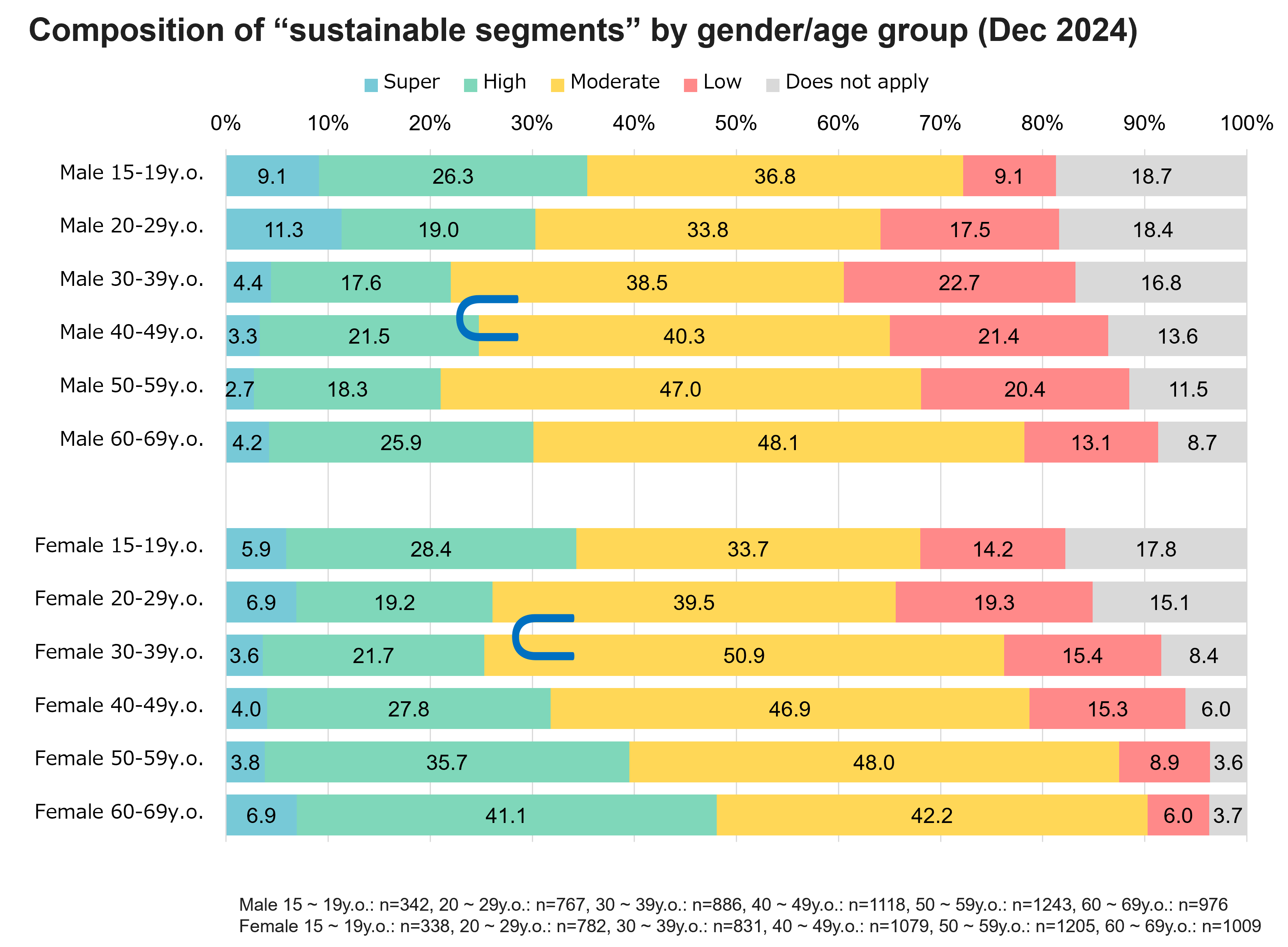
In addition, on observation of the composition of the sustainable segments by generation (Fig.6), a U-shared trend was observed for both men and women. Sustainable behavior tends to be higher among young men and women (15 ~ 29-year-olds), men in their 60s, and women in their 50s ~ 60s. Sustainable behavior decreased among those in their 30s and 40s who are raising children. There may be a relationship between busyness in life and sustainable behavior, with differences apparent between generations in terms of behavior too.
Fig.6
4. Do they select products based on their merits to “society” or “themselves”?
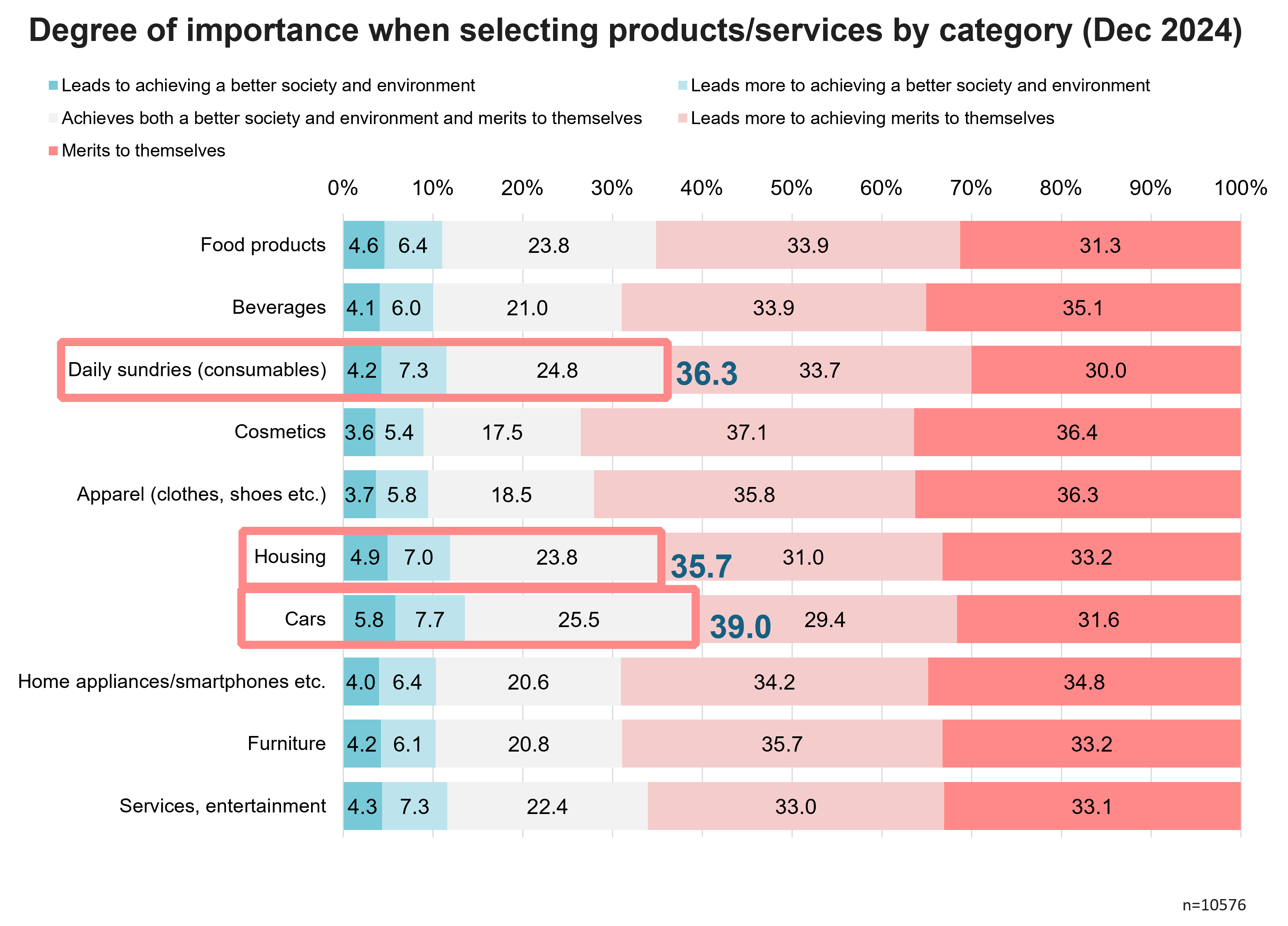
While many consumers are becoming aware of the word SDGs and gaining a greater understanding of what it means, what extent of them place importance on “Achieving a better society and environment” when choosing products and services? When we asked consumers which they placed more importance on, “Achieving a better society and environment” or “merits to themselves” by category, approximately 10% gave “Achieving a better society and environment”, approximately 20% gave “Achieving both a better society and environment and merits to themselves” and approximately 70% gave “merits to themselves” (Fig.7).
Fig.7
With “Daily sundries (consumables)”, “Cars”, and “Housing”, a quite high around 40% of consumers are conscious of ”Achieving a better society and environment” when selecting products. With “Cars”, the share of hybrid cars and EV cars is increasing. These offer both “merits to themselves” = energy conversation effects due to rising energy costs and “merits to society/the environment” in terms of preventing global warming. With “Housing”, homes are becoming more airtight and insulated, and solar panels and storage batteries are increasingly being installed. This delivers both reduced utilities costs = “merits to themselves” and serves as a global warming countermeasure = “merits to society/the environment”. Engagement with SDGs is thus likely to proceed through products and services in categories that tangibly convey both “merits to themselves” and “merits to society/the environment”.
5. Do consumers support companies that engage in SDGs?
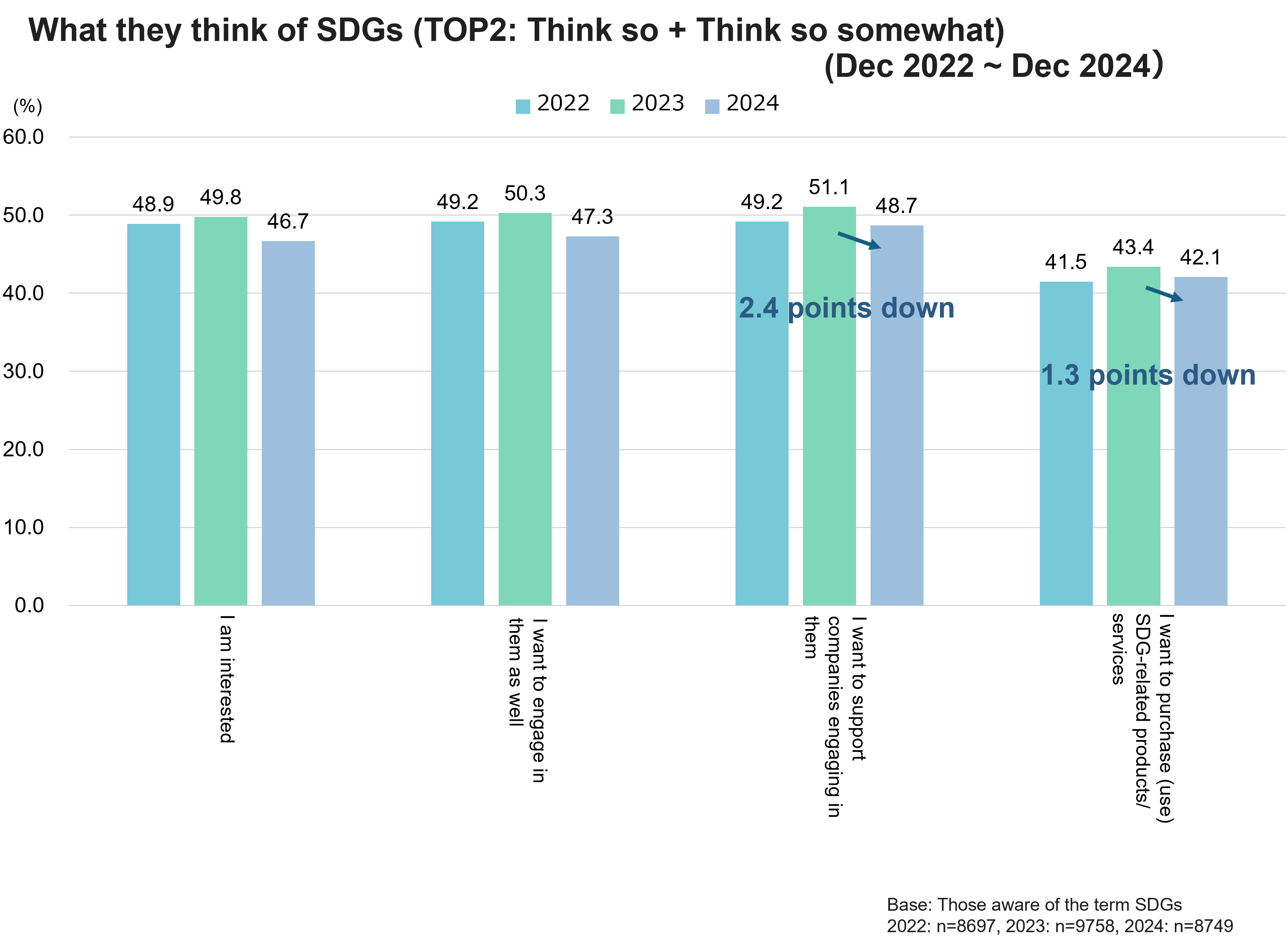
Fig.8 presents the results over the past 3 years on a question directed at people aware of the word “SDGs” on their interest in SDGs, and consciousness of companies and relevant products and services engaged in SDGs. On comparison of the latest results from December 2024 with those from December 2023, “I want to support companies engaged in SDGs” decreased by 2.4 points and “I want to purchase (use) SDG-related products/services” decreased by 1.3 points, with both on a slight downward trend.
Fig.8
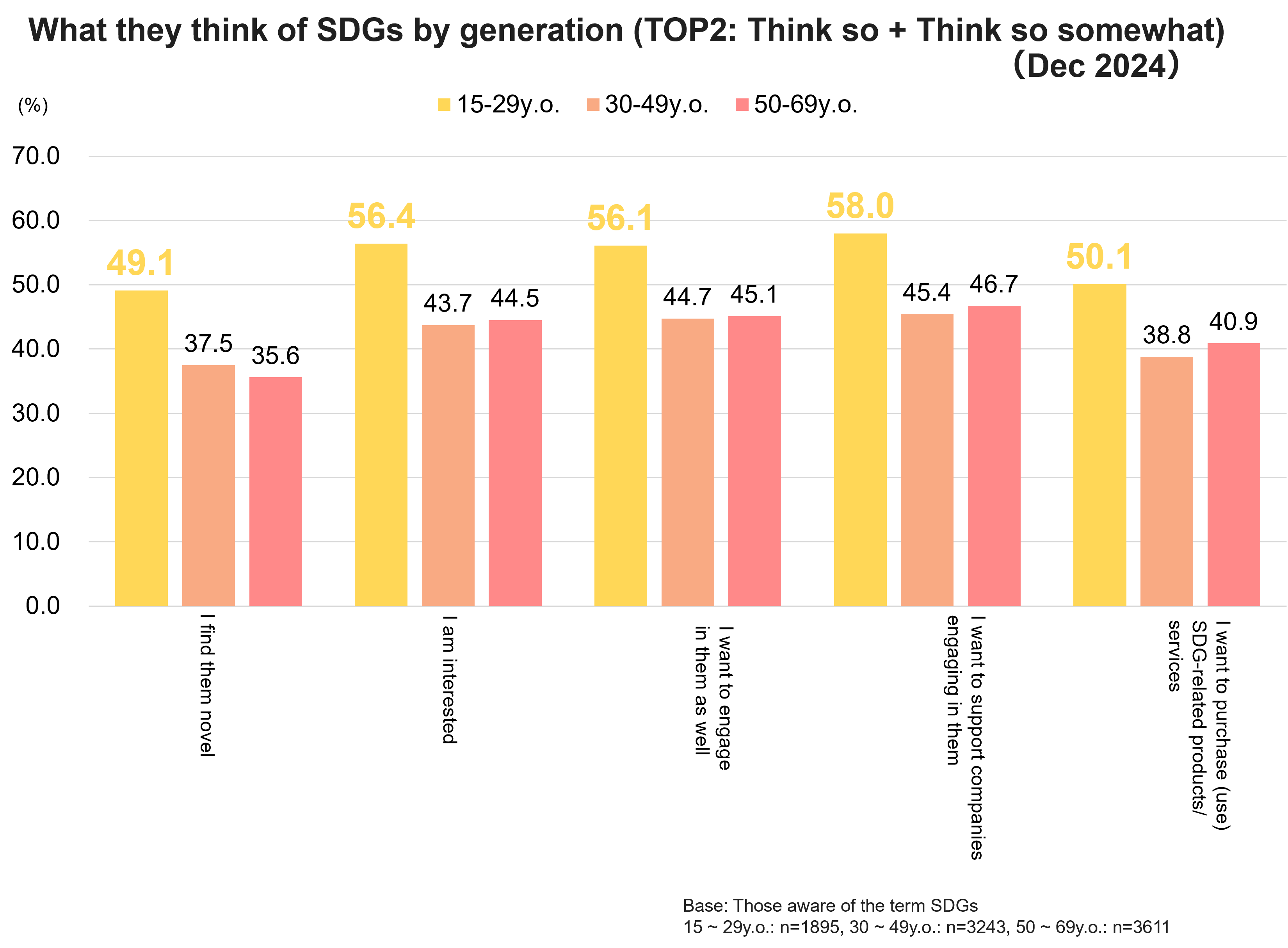
Fig.9 depicts these same findings on a generational base. “I want to support companies engaged in SDGs” rated 58.0% among 15 ~ 29-year-olds, 45.4% among 30 ~ 49-year-olds, and 46.7% among 50 ~ 69-year-olds, indicating around 60% of young people (15 ~ 29-year-olds) who have a greater understanding of SDGs want to support companies that are engaged in SDGs. “I want to purchase (use) SDG-related products/services” also rated 50.1% among 15 ~ 29-year-olds, 38.8% among 30 ~ 49-year-olds, and 40.9% among 50 ~ 69-year-olds.
Fig.9
Young people (15 ~ 29-year-olds) can be said to tend to be interested in the responses by companies to society and the environment, and select the products and services of companies engaged in SDGs due to their strong awareness of SDGs and understanding of what they are. It is thus crucial to properly convey a company’s SDGs and engagement in sustainability in branding and marketing aimed at young people.
6. Summary
SDGs have become broadly recognized over the past few years. Looking at consumers in general, this growth in SDG awareness and sustainable behavior is predicted to remain largely unchanged going forward. However, on observation by generation, it becomes apparent young people (15 ~ 29-year-olds) in particular possess a strong understanding of the nature of SDGs, a desire to support companies, and purchase products engaged in these efforts.
Young people (15 ~ 29-year-olds) are gaining a correct understanding of the 17 SDG objectives and the global environmental crisis at school. There is also a lot of talk on the environment and social issues on social media. Their exposure to this information is deemed to drive them to act with choosing products/services engaged in SDGs due to their deep-rooted sustainable behavior with the environment in mind.
While SDGs appear to have plateaued relatively, it is likely the heightened consciousness and action mainly among young people, who will be the core of society in future, will evoke an expansion in outlooks embracing SDGs and sustainability, as well as purchase behavior. From a corporate marketing perspective going forward, it is likely that products and services that do not align with these outlooks may increasingly fall out of favor with young people, so it will continue to be important to develop products and services embracing SDGs and sustainability, and to communicate relevant corporate messages.
Survey Area: Nationwide, Japan Respondent Criteria: Male and female individuals aged 15 ~ 69 Sample Extraction Method: Eligible extracted from Mighty Monitor Sample Size: Screener n=10576 Main questionnaire n=3629 Weight-back tabulation: None* *Gathered in line with gender, age group, and regional demographic composition based on national census Survey implementation period: (Fri) 20th December, 2024 ~ (Mon) 23rd December, 2024
Author profile
Kentaro Hama
Head of the Future Co-creation Center, Sales Promotion Division, Marketing Partner Headquarters 2, INTAGE Inc.
・After graduating from university, Hama worked for a home appliance manufacturer, and was responsible for product planning for word processors, faxes, mobile phones, video communication devices, and solar power generation.
・Joined INTAGE in 2013, and engaged in domestic and overseas consumer research and consulting.
・Established the “Future Co-creation Center” in 2017, which conducts a large amount of joint research projects (POC) and consumer research with a focus on creating new value through co-creation with companies.
・Currently interested in the well-being field
Participating in Datability Consortium Organization
Launched a “Well-being Committee” and is engaged in co-creation activities with different industries.
Head of the Future Co-creation Center, Sales Promotion Division, Marketing Partner Headquarters 2, INTAGE Inc.
・After graduating from university, Hama worked for a home appliance manufacturer, and was responsible for product planning for word processors, faxes, mobile phones, video communication devices, and solar power generation.
・Joined INTAGE in 2013, and engaged in domestic and overseas consumer research and consulting.
・Established the “Future Co-creation Center” in 2017, which conducts a large amount of joint research projects (POC) and consumer research with a focus on creating new value through co-creation with companies.
・Currently interested in the well-being field
Participating in Datability Consortium Organization
Launched a “Well-being Committee” and is engaged in co-creation activities with different industries.
Reproduction and Quotation
◆This report is copyrighted by INTAGE Inc. Please check the following prohibitions and precautions, and specify the source when reproducing or quoting this report. “Source: INTAGE “Knowledge Gallery” article published MM/DD/YYYY article”
◆The following are prohibited: ・Alteration of this article in full or in part ・Sale or publication of this article in full or in part ・Uses that are against public order and morality, and uses connected with illegal activities ・Reproducing or quoting panel data* for the purpose of advertising or promoting companies, products, or services *Panel data include: SRI+, SCI, SLI, Kitchen Diary, Car-kit, MAT-kit, Media Gauge, i-SSP, etc.
◆Other precautions: ・INTAGE Inc. shall not be liable for any trouble, loss, or damage caused by the use of this report ・These usage rules do not restrict the use of quotations or other uses permitted under the Copyright Act of Japan
◆For inquiries about reproduction and quotation, click here