What impact will the cocoa shock have on Valentine’s Day in 2025?
Valentine’s Day is approaching again this year. It’s a day synonymous with chocolate to many, but the price of cocoa beans, the main ingredient in chocolate, has risen sharply from last year, causing a situation known as the cocoa shock. Let’s examine how this phenomenon will impact Valentine’s Day this year based on the results of a voluntary survey conducted annually by INTAGE.
Valentine’s Day 2025: What will people’s budgets be this year?
Let’s first examine people’s budgets for Valentine’s Day this year. The average budget for women purchasing chocolate on their own is 4,574 yen. While last year, the average budget increased by 134.0% year-on-year due in part to post-covid era excitement, the average budget has not continued to rise for a second year in a row this year, and rates 91.0% against the previous year (Fig.1).
Fig.1
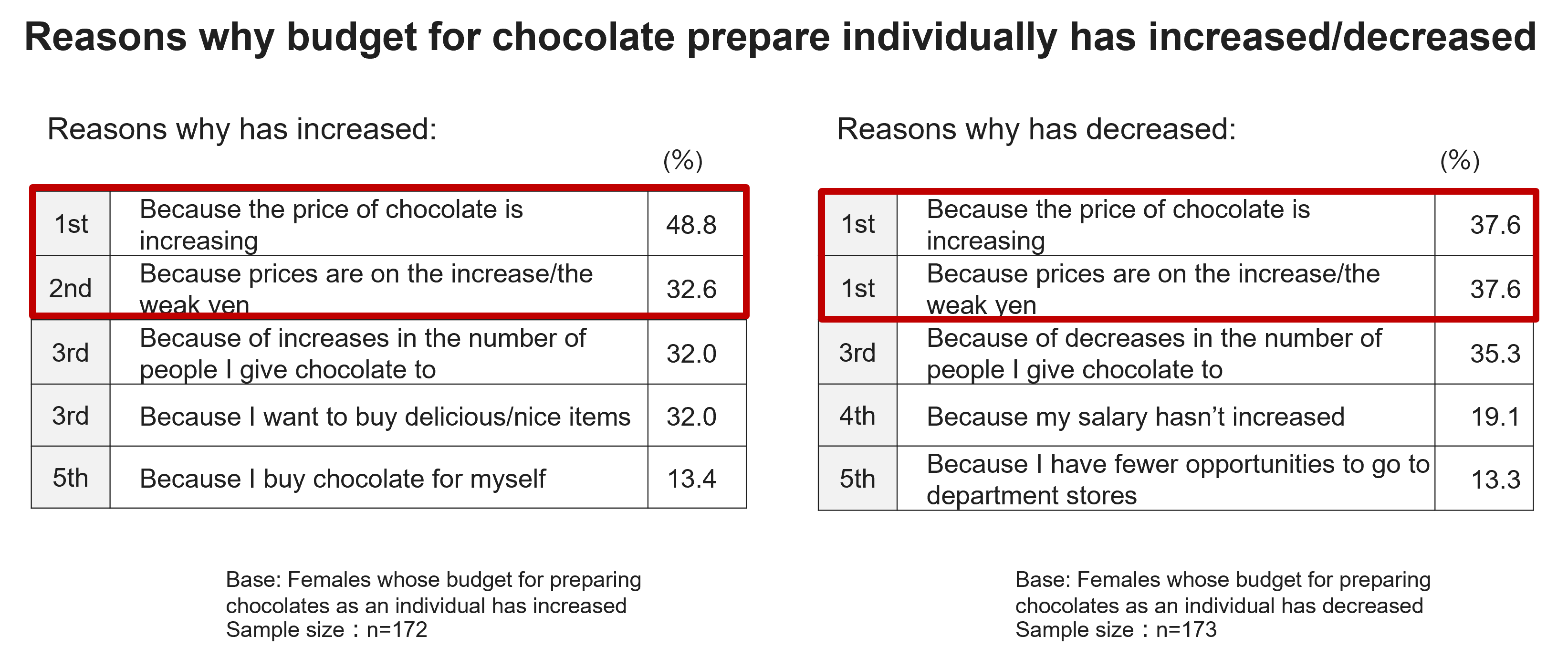
The top two reasons for increases/decreases in budget were “because the price of chocolate is increasing” and “because prices are on the increase/the weak yen”. “Because of increases/ decreases in the number of people I give chocolate to” ranked third (Fig.2). Valentine’s Day this year is likely to be strongly impacted by the cocoa shock and price increases.
Fig.2
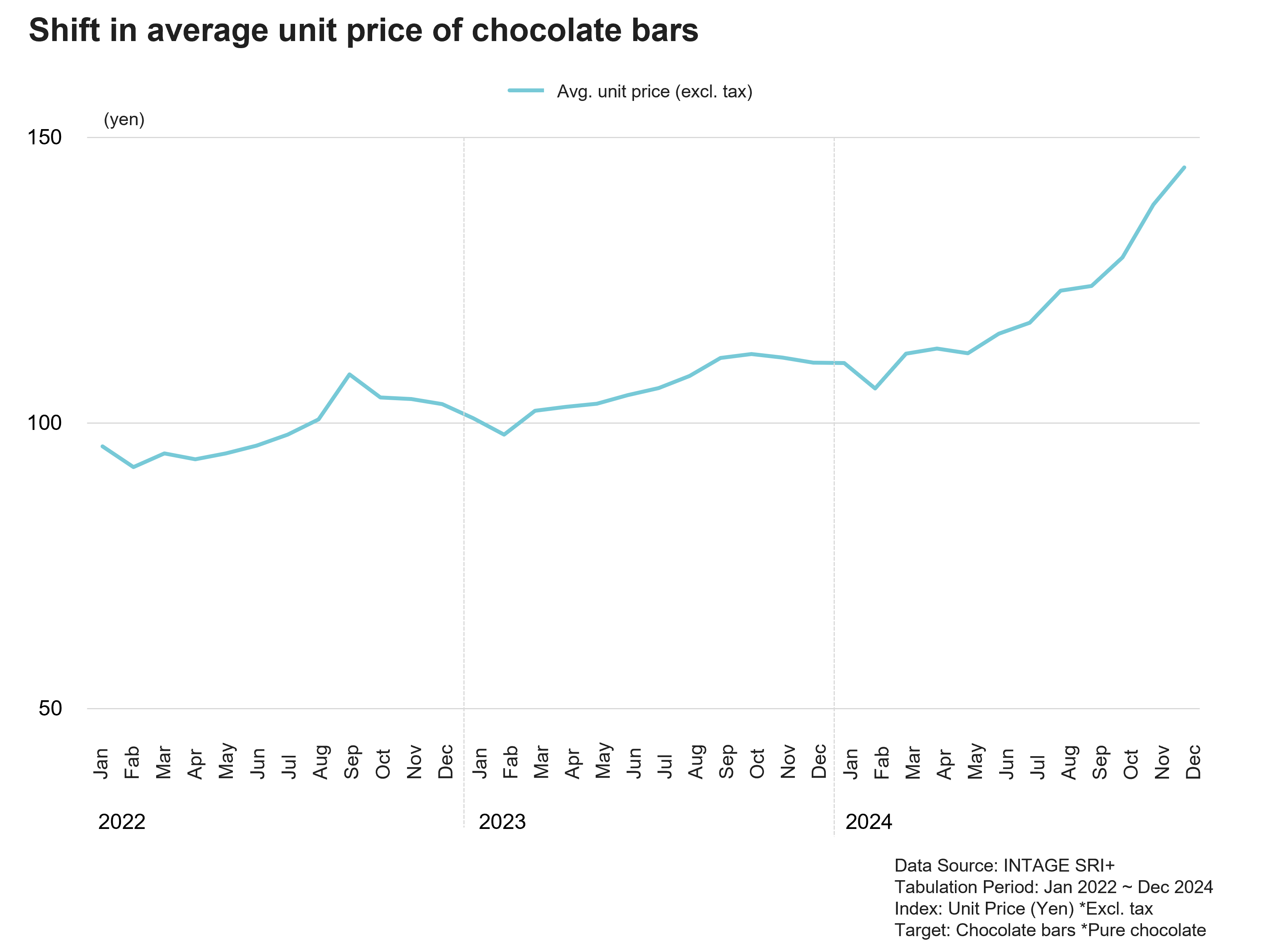
So how much is the price of chocolate actually increasing? We examined trends for the average unit price of chocolate bars using retail sales data from INTAGE’s SRI+® (Nationwide Retail Store Panel Survey), which continuously collects sales results from 6,000 stores nationwide. The unit price, which was under 100 yen at the beginning of 2022, has been gradually increasing, and rose sharply in the second half of 2024 (Fig.3). This is due to the rise in the price of cocoa beans.
Fig.3
How will people’s behavior change driven by the price increase in chocolate?
Are consumers aware of this increase in the price of chocolate? 72.0% of the female total responded that they “knew” about the increase in the price of chocolate. Purchase behavior this year is thus also likely to reflect a consciousness of this price increase. When asked if their behavior would be affected if Valentine’s Day chocolate prices increased this year, 67.4% of females who planned on buying chocolate for Valentine’s Day responded it would have some sort of impact. Many commented they “Would buy chocolate in a lower price band” (32.9%), “Reduce the number of items they buy” (22.3%), or “Buy them from a cheaper store” (21.5%), followed by “Buy less/stop buying chocolate for myself” (9.5%), and “Buy less/stop buying ‘obligatory chocolate’” (tied at 7.7%) (Fig.4).
Fig.4
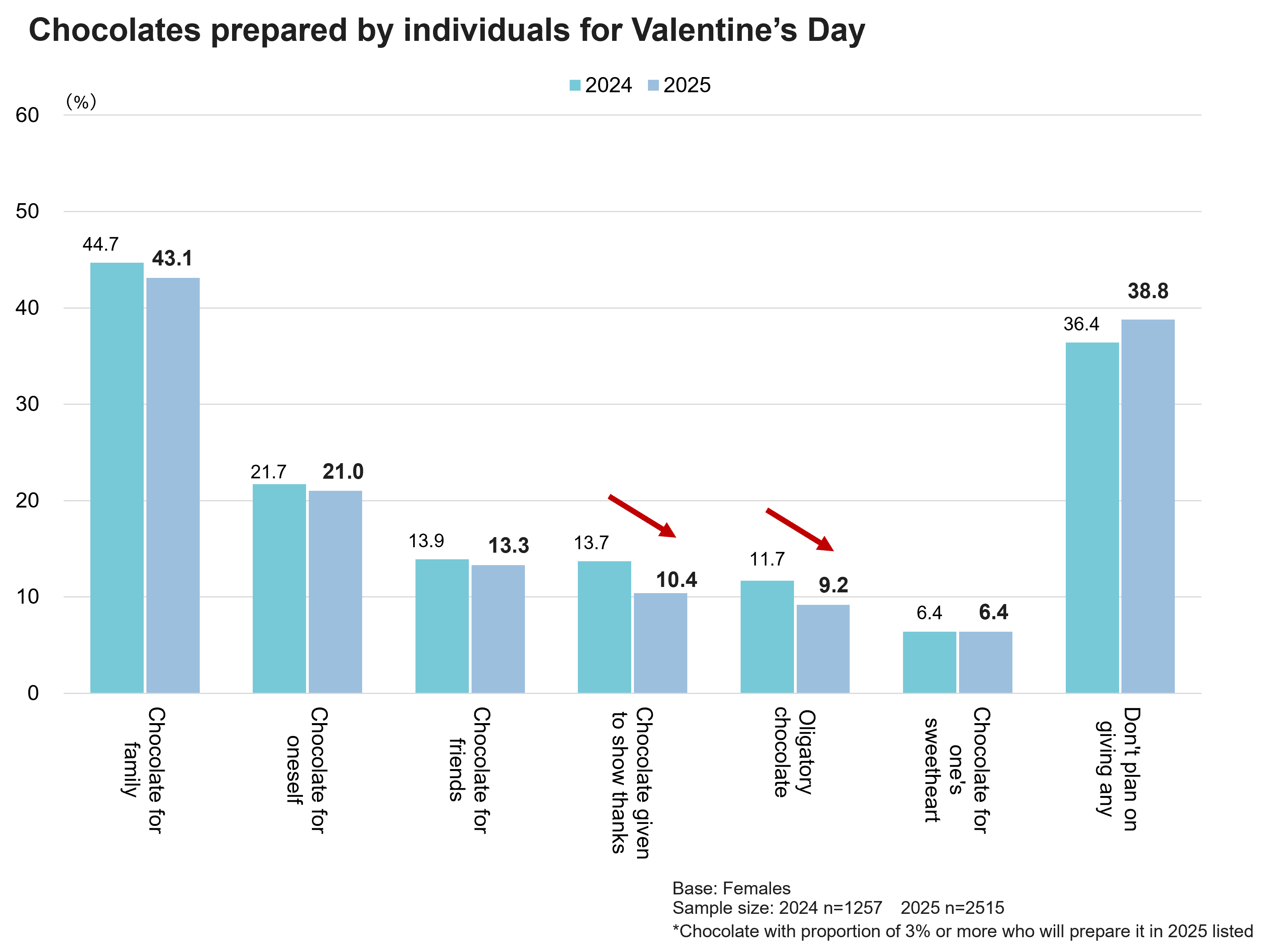
On observation of the types of chocolates purchased by individuals, “chocolate given to show thanks” (10.4%: 75.9% compared to the previous year) and “obligatory chocolate” (9.2%: 78.6% compared to the previous year) decreased sizably (Fig.5), which appears to be a driver in their decreased budgets. In addition, even “obligatory chocolate”, purchased by multiple individuals at workplaces etc., decreased 2.9 points compared to the previous year to 11.2% among working females.
Fig.5
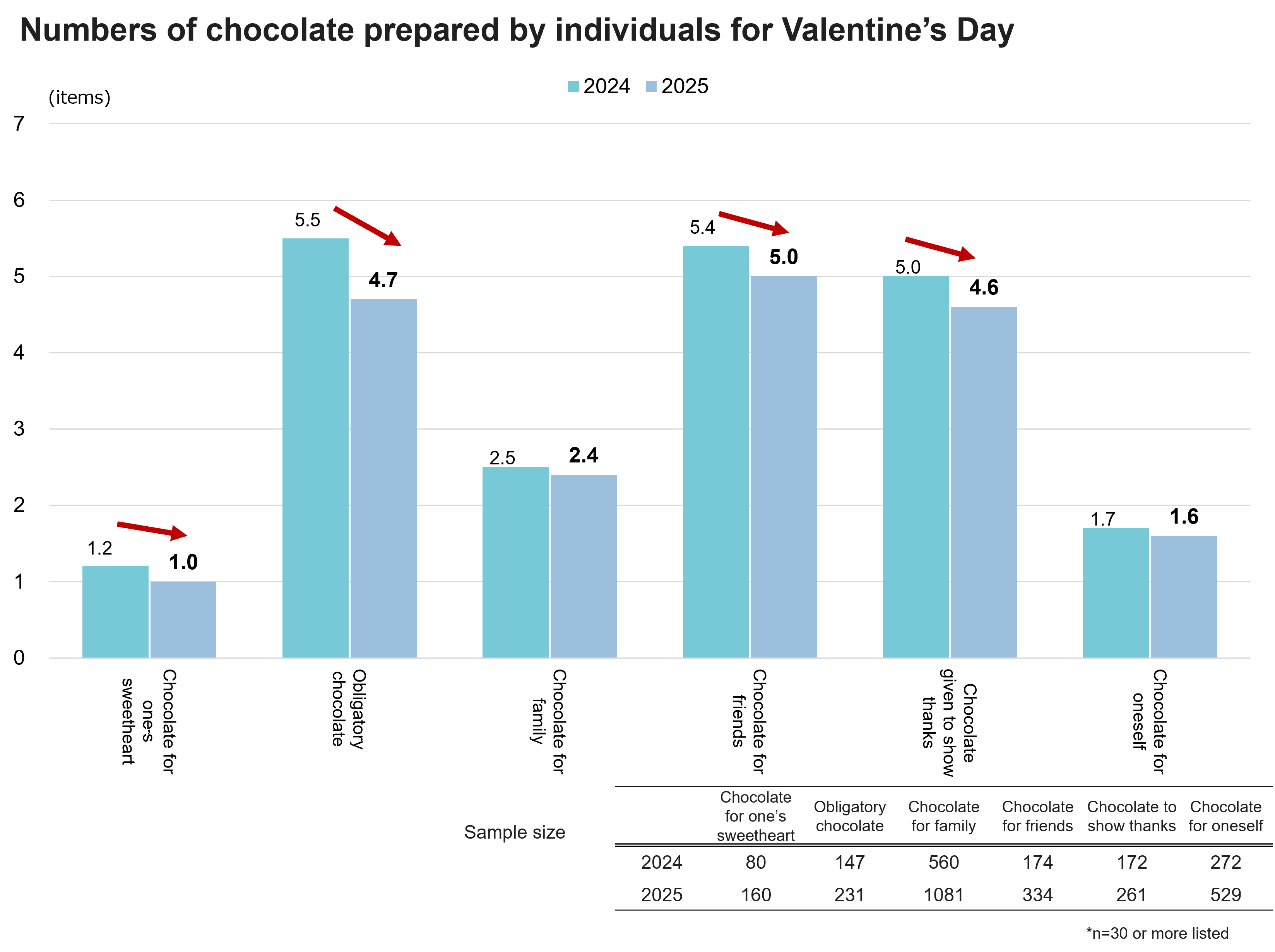
Similarly, on observation of the number of items purchased by type of chocolate, there was an overall decrease (Fig.6). The decrease in the number of obligatory chocolate items purchased was particularly conspicuous.
Fig.6
What will happen to Japan’s “obligatory chocolate” culture in future?
With the particularly sizable decrease clear in “obligatory chocolate”, have consumers’ sentiments changed? Upon asking working females about their participation in purchasing obligatory chocolate in their workplaces, 84.2% responded “I’d prefer not to participate”. This response has rated highly for the past 4 years, and increased further, albeit slightly, this year (Fig.7).
Fig.7
Lots of people were observed to reduce the number of items they purchase as a means to deal with the price increase, with obligatory chocolate a conspicuously common target for these reductions, indicating that the culture of obligatory chocolate may continue to fade.
Valentine’s Day this year comes amidst the increase in the price of cocoa and prices in general. We will continue to research how events change going forward in future as well.
Reproduction and Quotation
◆This report is copyrighted by INTAGE Inc. Please check the following prohibitions and precautions, and specify the source when reproducing or quoting this report. “Source: INTAGE “Knowledge Gallery” article published MM/DD/YYYY article”
◆The following are prohibited: ・Alteration of this article in full or in part ・Sale or publication of this article in full or in part ・Uses that are against public order and morality, and uses connected with illegal activities ・Reproducing or quoting panel data* for the purpose of advertising or promoting companies, products, or services *Panel data include: SRI+, SCI, SLI, Kitchen Diary, Car-kit, MAT-kit, Media Gauge, i-SSP, etc.
◆Other precautions: ・INTAGE Inc. shall not be liable for any trouble, loss, or damage caused by the use of this report ・These usage rules do not restrict the use of quotations or other uses permitted under the Copyright Act of Japan
◆For inquiries about reproduction and quotation, click here