Inbound tourism is evolving into “consumption of things x consumption of experiences”: Uniquely Japanese experiences sought by foreign visitors to Japan
Numbers of foreign tourists visiting Japan in 2024 reached a record high of 3,489,800 in December, the highest number ever recorded for a single month. The number of foreign visitors for the entire year of 2024 exceeded 36 million, the highest number of visitors to date (*1). Readers have probably also noticed the number of foreign visitors to Japan has increased, not only in the Tokyo metropolitan area and tourist destinations, but regional cities as well. Japan is experiencing an “inbound tourism whirlwind”, with the travel expenditure (preliminary figures) of foreign visitors to Japan is expected to reach an all-time high of 8.1 trillion yen (53.4% up from 2023) in 2024 (calendar year) (*2) Amidst this status quo, the number of foreigners who have visited Japan multiple times (herein referred to as inbound tourists) is also on the increase. We conducted research on the experiences of inbound tourists visiting Japan from the US, Taiwan, Hong Kong, and Thailand in February to March, 2025 focusing on their purpose of visits, and changes in experiences and shopping in Japan with the cooperation of Payke Inc. (*3)
*1 Released by JNTO *2 Released by Ministry of Land, Infrastructure, Transport, and Tourism *3 Payke Inc: Operates an app that enables foreign visitors to Japan to check detailed information and reviews in their own language simply by scanning the barcodes of products. The app has been downloaded over 5 million times in total, is used by many inbound tourists, and offers a wealth of data on consumption-related behavior, such as scan history and interests.
1. How many times do they visit, how many nights do they stay, and how much do they spend? Exploring the state on inbound tourism
Firstly, let’s compare the state of stays by inbound tourists from their respective countries.
1) Number of visits to Japan (Number of repeat visits)
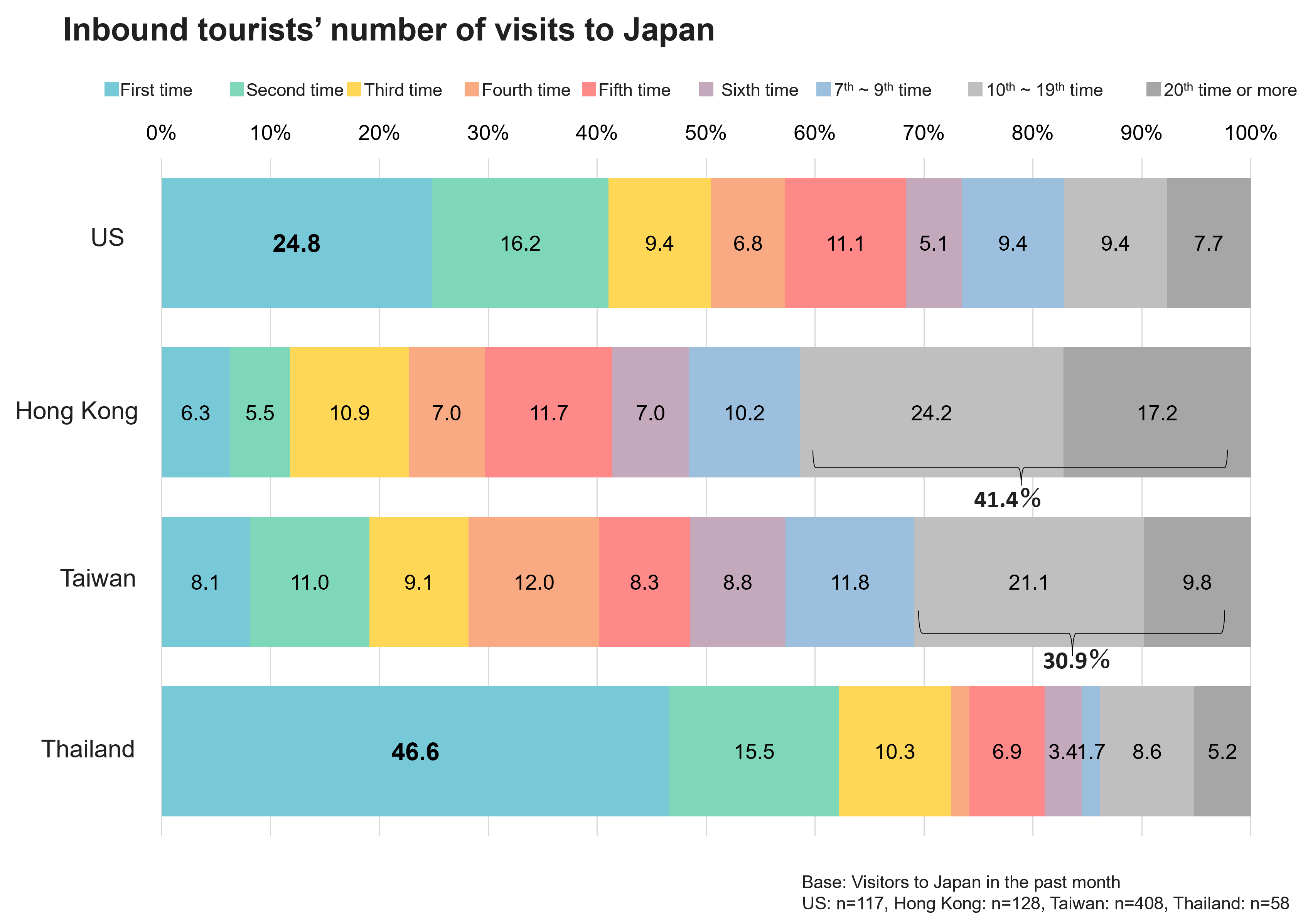
Inbound tourists’ number of visits to Japan are depicted in Fig.1. The countries with the greatest number of inbound tourists visiting Japan for the first time were the US (24.8%) and Thailand (46.6%). On the other hand, the countries the highest number of visits to Japan are seen with are Hong Kong and Taiwan, with 41.4% repeaters who have visited more than 10 times in Hong Kong. It is thus apparent that there are many inbound tourists who repeatedly visit Japan. Repeat visitors must find something about Japan appealing or beneficial in some way, which is why they visit multiple times. In this survey, we asked repeat visitors who have visited Japan multiple times about their experiences in their current visit to Japan, as well as their experiences during their previous visits to Japan, and clarify changes in inbound experiences.
Fig.1
2) Length of stay in Japan
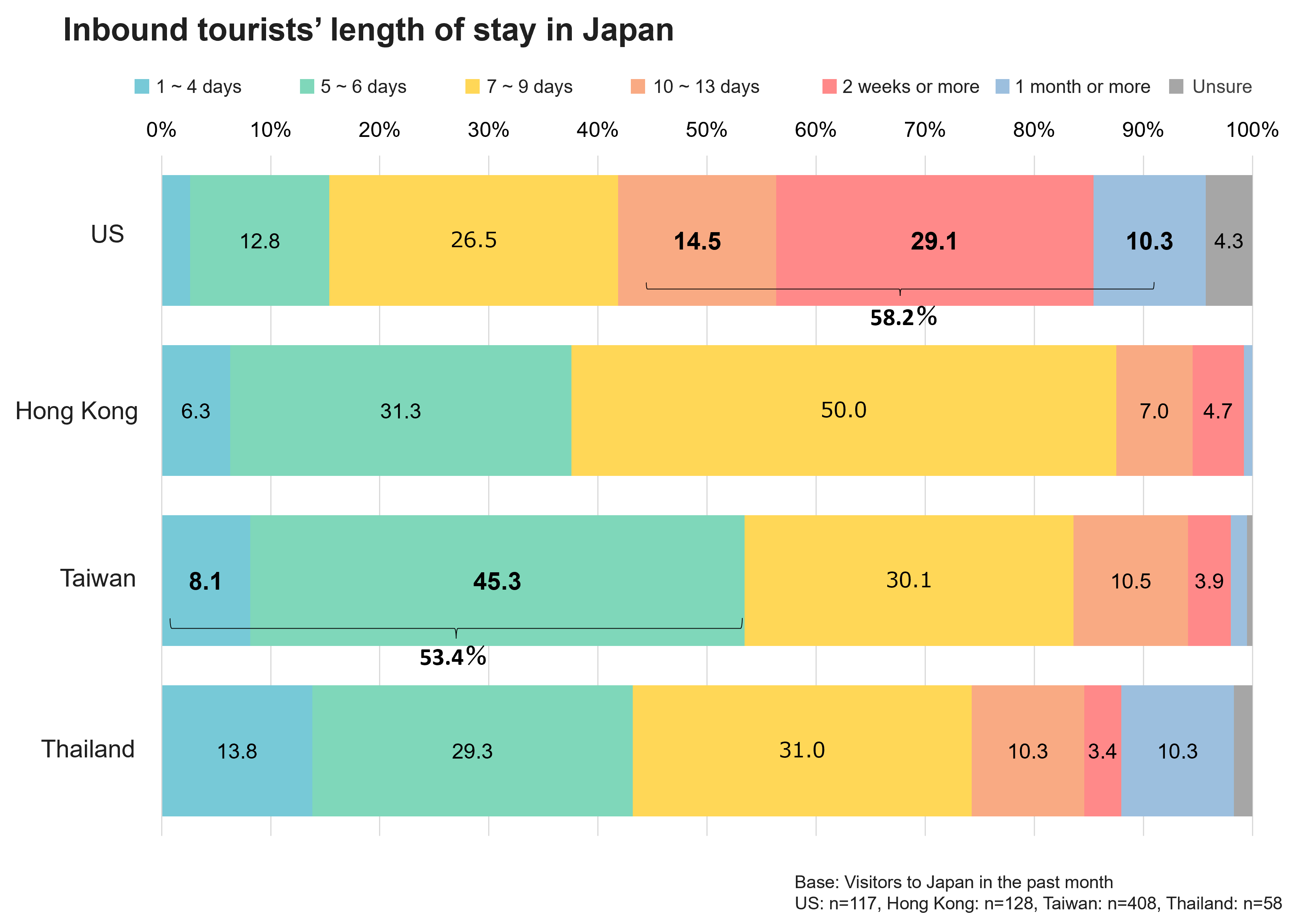
Tendencies in lengths of stay in Japan differ between the four countries and region (the US, Hong Kong, Taiwan, and Thailand). Fig.2 presents a summary of length of stay by country. 58.2% of inbound tourists from the US stayed in Japan for 10 days or more. 53.4% of inbound tourists from Taiwan stayed in Japan for 6 days or less. Inbound tourists from further afield thus have longer lengths of stay, while those visiting from Taiwan and Hong Kong have shorter lengths of stay, and visit Japan multiple times as seen in Fig.1.
Fig.2
3) Amount of expenditure during visit to Japan (expenses for visiting Japan)
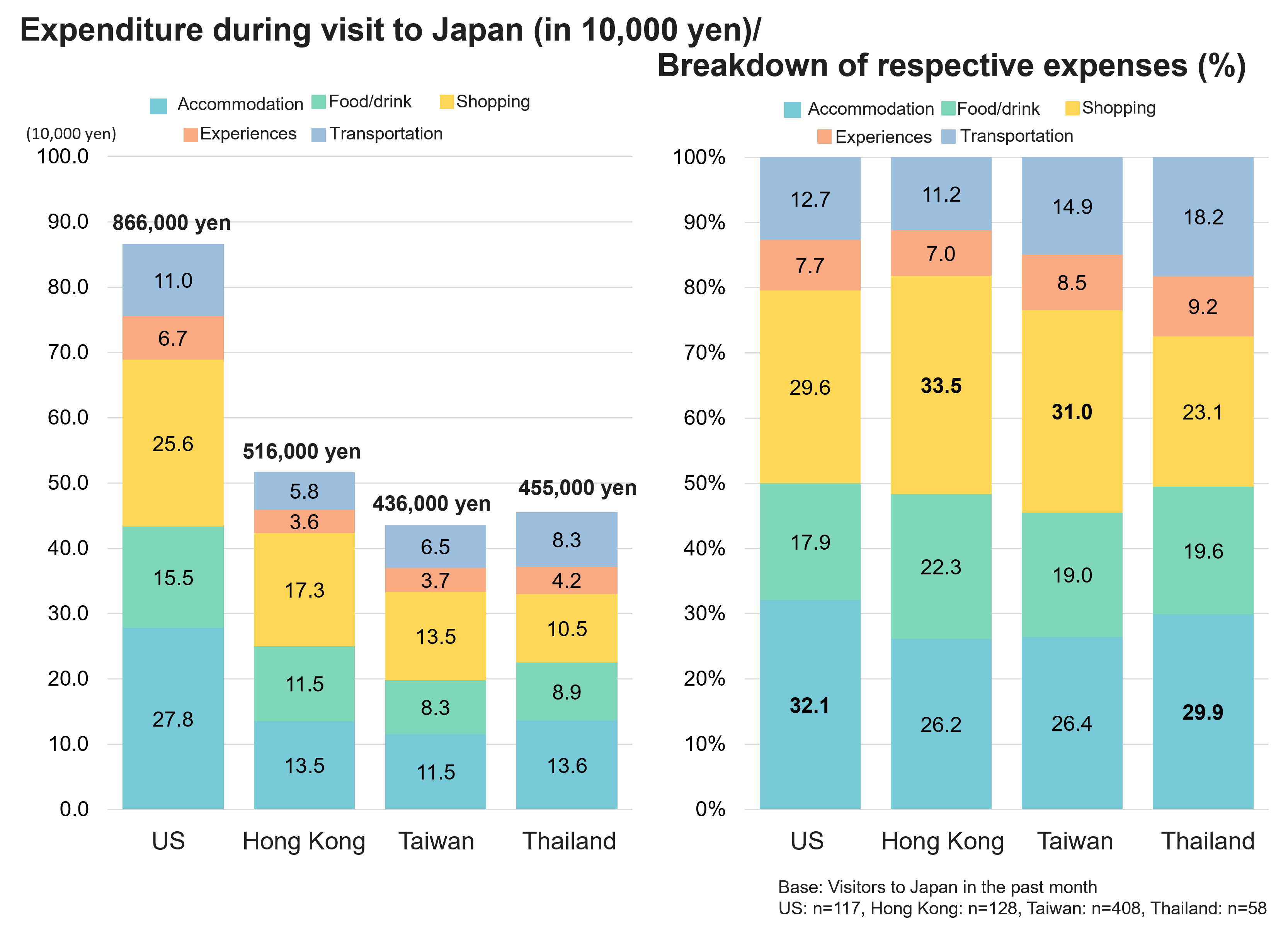
Fig.3 presents the amount inbound tourists spend during their visits to Japan including accommodation, food and drink, shopping expenses, expenses for experiences, transportation expenses (including the cost of getting to Japan), and their average overall spend. Fig.4 presents a breakdown of this expenditure. The most common overall expenditure per visit to Japan was highest at 866,000 yen with the US, followed by 516,000 yen with Hong Kong. With this appears high when converted to Japanese yen, Japan probably presents “good value” as a destination from an inbound tourist’s perspective considering the fact the yen is weak, and costs in various other countries are on the rise.
On observation of the breakdowns of the respective expenses of inbound tourists from the respective countries and regions, shopping made up the greatest proportion of expenses at 33.5% with inbound tourists from Hong Kong, whose average expenditure was 173,000 yen. This was followed by 31.0% with inbound tourists from Taiwan, whose average expenditure was 135,000 yen, indicating that tourists are enjoying shopping in Japan thanks to the weak yen. With inbound tourists from the US and Thailand, accommodation makes up 30% of expenses, which may be due to their greater lengths of stay. This also seems to be affected by rising hotel prices in Japan.
Fig.3 Fig.4
2. Changes in purposes of visits, experience and shopping behavior
As seen in Fig.1, many inbound tourists visit Japan multiple times, with inbound tourists now also being a common sight in regional areas other than the major tourist destinations. Our hypothesis is that the purposes of visits and the experiences of inbound tourists centering on repeat visitors are changing. From this point onwards, we will take a look at the survey results on experiences during their stays in Japan, focusing mainly on repeat visitors.
1) Changes in the purposes of visits to Japan
Let’s first take a look at the purposes of visits to Japan. The top three purposes this time were “Tourism (nature)” at first place at 62.5%, “Shopping” at second place at 53.1%, and “Tourism (famous/historic sites)” at third place at 51.6%.
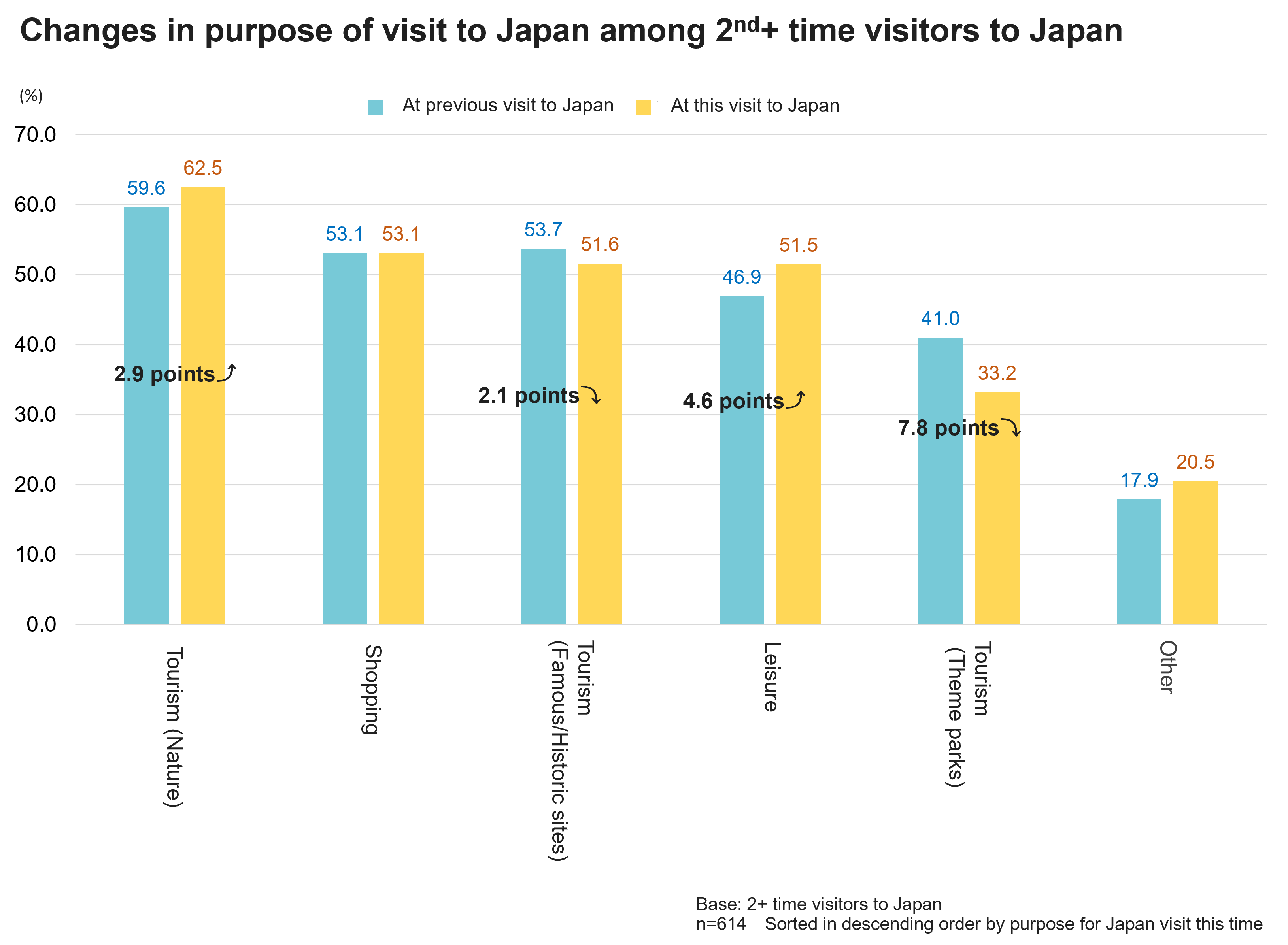
Filtering this down next to those who have visited Japan two or more times, on observation of the differences between purposes of their previous visit and purposes of their present visit, increases of 4.6 points for “Leisure”, and 2.9 points for “Tourism (nature)” were observed respectively (Fig.5). Conversely, a decrease of 7.8 points for “Tourism (theme parks)” was observed. “Shopping” remained largely unchanged, and appears an essential part of visits to Japan.
It is apparent that from their second visit onwards, their purposes of visiting Japan are Japan’s rich nature and leisure experiences. While inbound “consumption of goods” remains strong, as the number of inbound tourists who visit Japan multiple times increases, it is likely “consumption of experiences” such as travel plans that include not only famous tourist spots but also exploring nature in regional areas as well as leisure experiences will continue to increase in line with their purposes of visits to Japan in future.
Fig.5
2)Changes in their experiences during visits to Japan
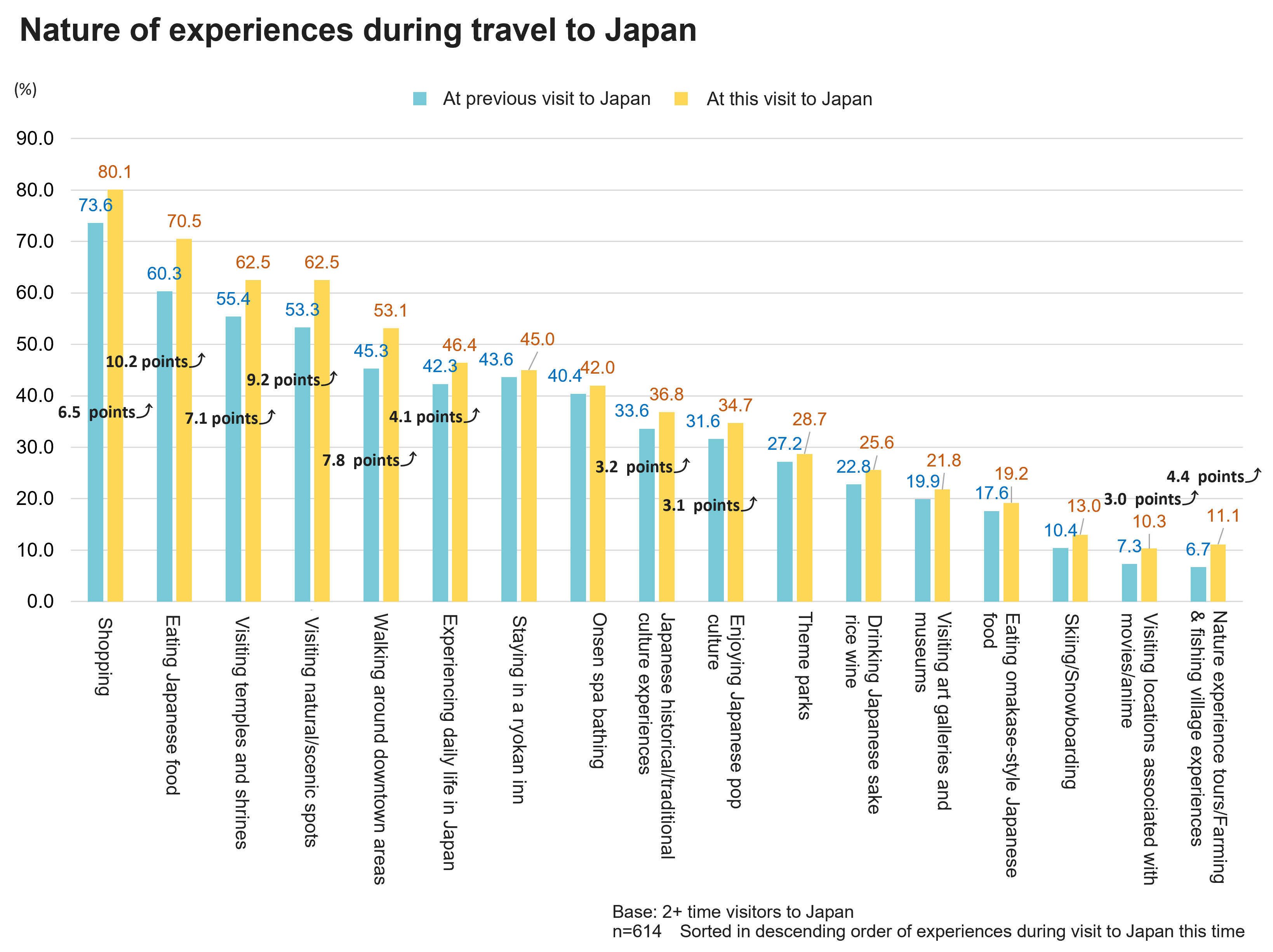
Next, let’s examine the sorts of experiences inbound tourists are having during their visits to Japan. Fig.6 presents the experience shad by inbound tourists who have visited Japan twice or more. Once again, on observation of the differences between experiences in their previous visit and experiences in their present visit, “Eating Japanese food” increased by 10.2 points, “Visiting natural and scenic spots” increased by 9.2 points, “Walking around downtown areas” increased 7.8 points, and “Visiting temples and shrines” increased 7.1 points, indicating that inbound tourists are exploring and enjoying Japan more deeply on their second and later visits. At the same time, less of an increase is observed on “Staying at a ryokan inn” and “Bathing in hot springs” than other experiences. This suggests that rather than simply ryokan inn/hot spring experiences, providing a set of experiences in an area (such as meals, as well as walking around exploring the area) may be more desirable to inbound tourists who visit multiple times.
Fig.6
3)Changes in items purchased
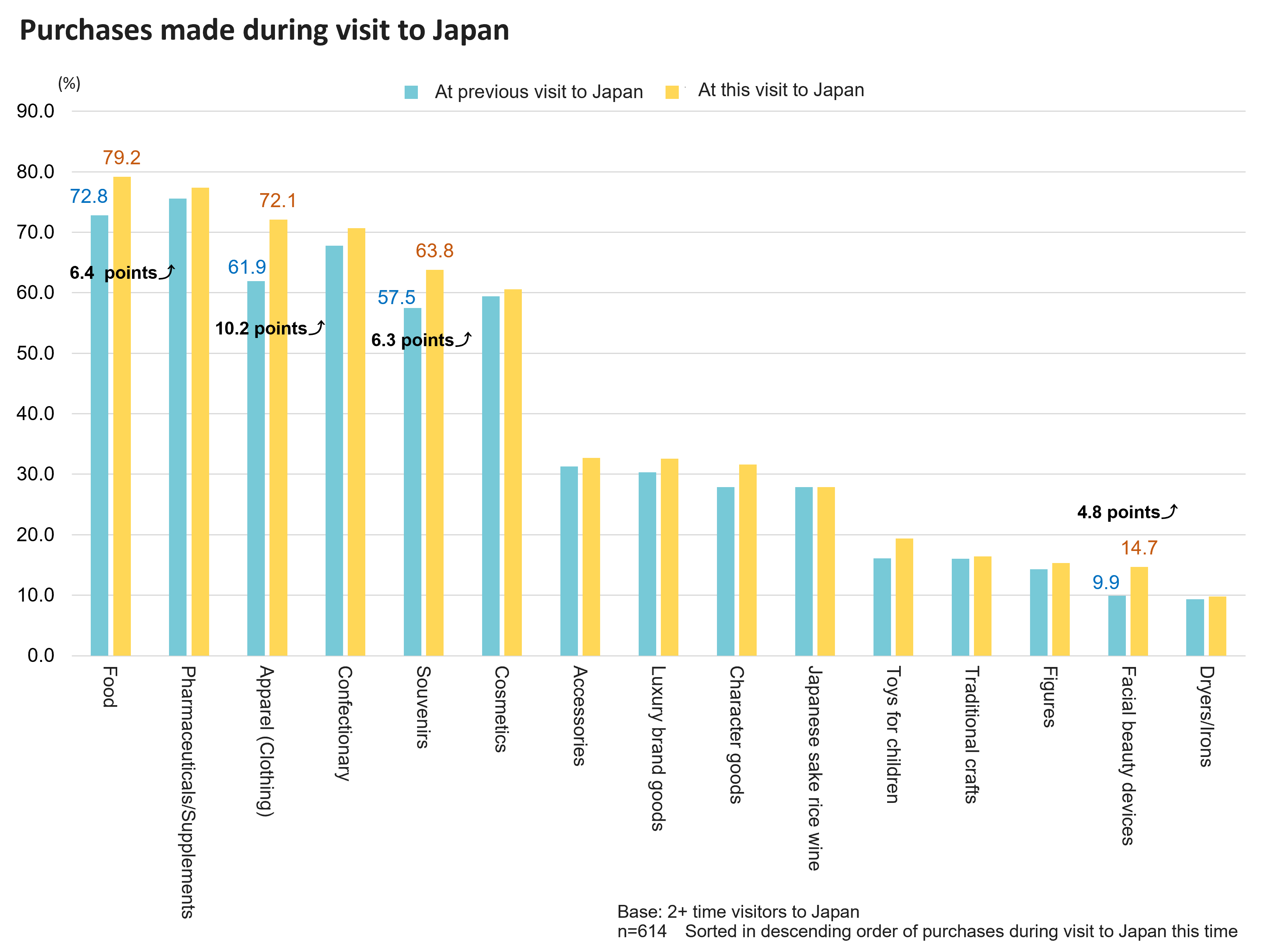
Next, Fig.7 presents the purchases made during inbound tourists’ present visit and previous visit to Japan. The top items purchased during their present visit were “Food” at 79.2%, “Pharmaceuticals/supplements” at 77.4%, and “Apparel (clothing)” at 72.1%. The items purchased showing the greatest difference in purchase rate from their previous visit were “Apparel (clothing)”, which was up 10.2 points; “Food”, which was 6.4 points up; “Souvenirs (for others)”, which was up 6.3 points; and “Facial beauty devices”, which was up 4.8 points, with all these products showing increases. On observation of purchases by country, with inbound tourists from the US, “Cosmetics” increased 17.0 points, and “Facial beauty devices” increased 17.1 points, while with inbound tourists from Hong Kong, “Apparel (clothing)” increased 14.2 points, and “Luxury brand goods” increased 10.9 points, while with inbound tourists from Taiwan, “Apparel (clothing)” increased 10.4 points. It is likely the products of Japanese apparel, cosmetics, and beauty appliance manufacturers that have expanded into overseas markets may be better deals in Japan due to the weak yen. It is thus also apparent that what inbound tourists are purchasing is gradually changing.
Fig.7
3. Conclusion
Thanks to the intensification of economic activity globally post-Covid, as well as the positive impact of the weak yen, the number of inbound tourists visiting Japan has exceeded 36 million annually, with their total consumption also rising to 8.1 trillion yen. Japan is now also attracting attention as a “good value” travel destination due to its weak yen. However, this will be temporary, and this boom will not expand further unless new value continues to be provided each time to inbound tourists (repeaters) visiting Japan multiple times. This survey identified that repeaters are increasingly engaging in “nature”, “leisure” and “exploring around town”-type experiences during visits to Japan. In order to ensure repeaters are satisfied, it will be important to provide services in line with the needs of inbound tourists. The key to ensure this boom does not end as a passing fad will be to continue to provide experiences that have not been fully introduced to date, such as “beautiful nature nationwide throughout Japan” and “leisure leveraging Japan’s unique culture, history, and nature”.
Research Outline Survey Areas: US, Hong Kong, Taiwan, Thailand Respondent criteria: 20 ~ 59-year-old male/female individuals Sample extraction method: Eligible individuals extracted from Payke app users Sample size: US:n=117, Hong Kong: n=128, Taiwan: n=408, Thailand: n=58 (Inbound tourists within a month after Japan visit were this survey’s targets) Weighting: None Survey implementation period: (Fri) February 2 ~ (Sun) March 9, 2025
Author profile
Kentaro Hama
Future Co-creation Center, Sales Promotion Division, Marketing Partner Headquarters 2, INTAGE Inc.
・After graduating from university, Hama worked for a home appliance manufacturer, and was responsible for product planning for word processors, faxes, mobile phones, video communication devices, and solar power generation.
・Joined INTAGE in 2013, and engaged in domestic and overseas consumer research and consulting.
・Established the “Future Co-creation Center” in 2017, where he has conducted a large amount of joint research projects (POC) and consumer research with a focus on creating new value through co-creation with companies.
・Currently interested in the well-being field
Participating in Datability Consortium Organization
「Launched a “Well-being Committee” and is engaged in co-creation activities with different industries.
Future Co-creation Center, Sales Promotion Division, Marketing Partner Headquarters 2, INTAGE Inc.
・After graduating from university, Hama worked for a home appliance manufacturer, and was responsible for product planning for word processors, faxes, mobile phones, video communication devices, and solar power generation.
・Joined INTAGE in 2013, and engaged in domestic and overseas consumer research and consulting.
・Established the “Future Co-creation Center” in 2017, where he has conducted a large amount of joint research projects (POC) and consumer research with a focus on creating new value through co-creation with companies.
・Currently interested in the well-being field
Participating in Datability Consortium Organization
「Launched a “Well-being Committee” and is engaged in co-creation activities with different industries.
Reproduction and Quotation
◆This report is copyrighted by INTAGE Inc. Please check the following prohibitions and precautions, and specify the source when reproducing or quoting this report. “Source: INTAGE “Knowledge Gallery” article published MM/DD/YYYY article”
◆The following are prohibited: ・Alteration of this article in full or in part ・Sale or publication of this article in full or in part ・Uses that are against public order and morality, and uses connected with illegal activities ・Reproducing or quoting panel data* for the purpose of advertising or promoting companies, products, or services *Panel data include: SRI+, SCI, SLI, Kitchen Diary, Car-kit, MAT-kit, Media Gauge, i-SSP, etc.
◆Other precautions: ・INTAGE Inc. shall not be liable for any trouble, loss, or damage caused by the use of this report ・These usage rules do not restrict the use of quotations or other uses permitted under the Copyright Act of Japan
◆For inquiries about reproduction and quotation, click here