Consumers have changed of late due to recent high prices, the weak yen, and prolonged economic stagnation, as well as the impact of covid, and they are increasingly tending to seek special and moving experiences over material things. While the focus tends to be on “saving time” including the “time performance consciousness” spreading mainly among Gen Z, based on the fundamental value of “wanting to value time”, so they appear to also place importance on how enriched the time they spend is. We thus conducted a survey with INTAGE’s consumer panel SCI® monitor panelists on enjoying the process ,or “process performance consciousness*” linked with closely related categories, age groups, and behavior. *Process performance: The idea that as consumers’ polarization between wanting to save time and wanting to leisurely take one’s time advances, that the process may be able to be made into a satisfying performance that satisfies their desire to enjoy the process April 1, 2024 Kiyota Sangyo Co., Ltd. Extracted from “2024 Food Market Trend Forecasts: Best 10 Hit Keywords” Author: Tomoko Yamashita, CEO of Himeko Company Co., Ltd, Visiting Professor at Japan Women’s University of Nutrition https://www.kiyota-s.com/kiyota-diary/2154
2. Categories closely related to process performance consciousness
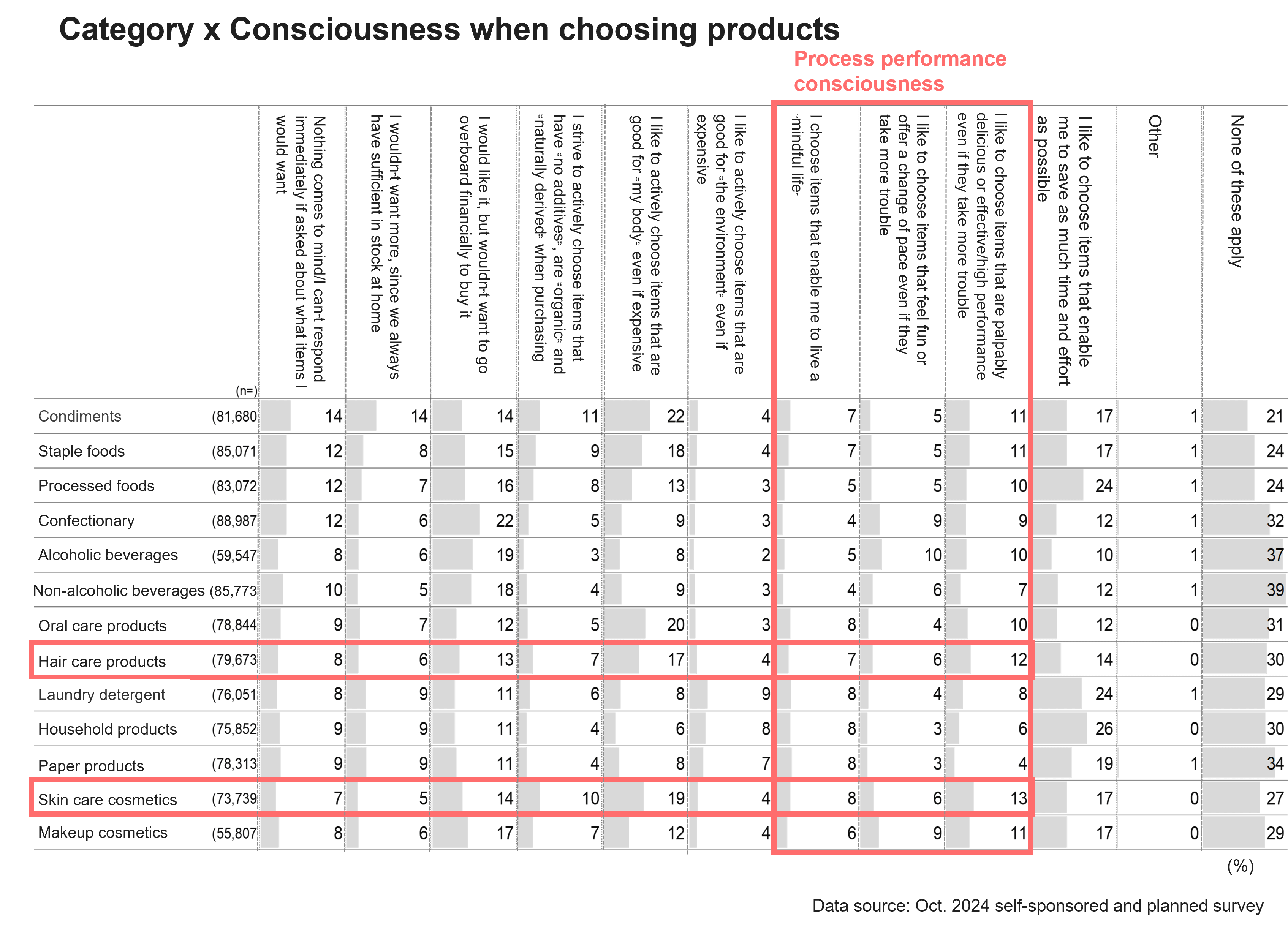
Fig.1 is a table depicting the results of when consumers were asked what they are conscious of when purchasing respective product categories. We defined attributes such as “I choose items that enable me to live a ‘mindful life’”, “I like to choose items that feel fun or offer a change of pace even if they take more trouble”, and “I like to choose items that are palpably delicious or effective/ high performance even if they take more trouble” as indicative of the tendency to place importance on process performance consciousness. While no sizable differences existed between product categories, haircare products and skincare products can be said to be categories in which consumers have a relatively strong tendency to place importance on process performance consciousness.
Fig.1
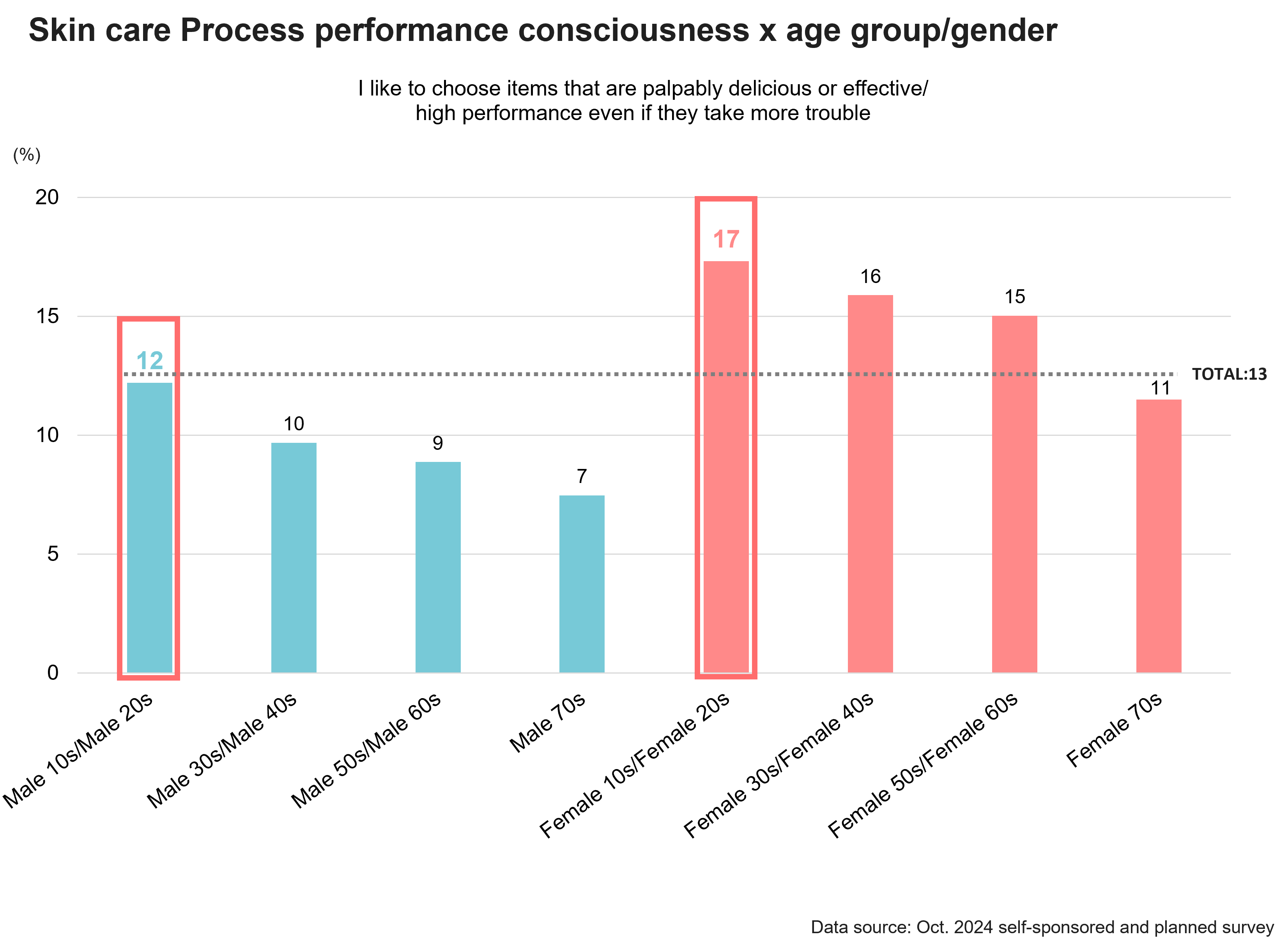
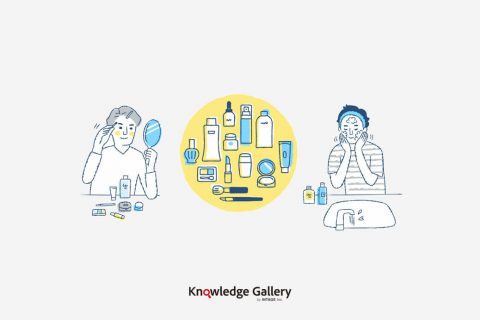
Let’s now take a look at the process performance consciousness “I like to choose items that are palpably delicious or effective/ high performance even if they take more trouble” by gender and age group with skincare products, in which consumers tend to place relatively more importance on process performance consciousness. It is apparent that the younger the age group, the more highly process performance conscious they are for both males and females.
Fig.2
So, is this higher than time performance consciousness, said to be particularly high among young people?
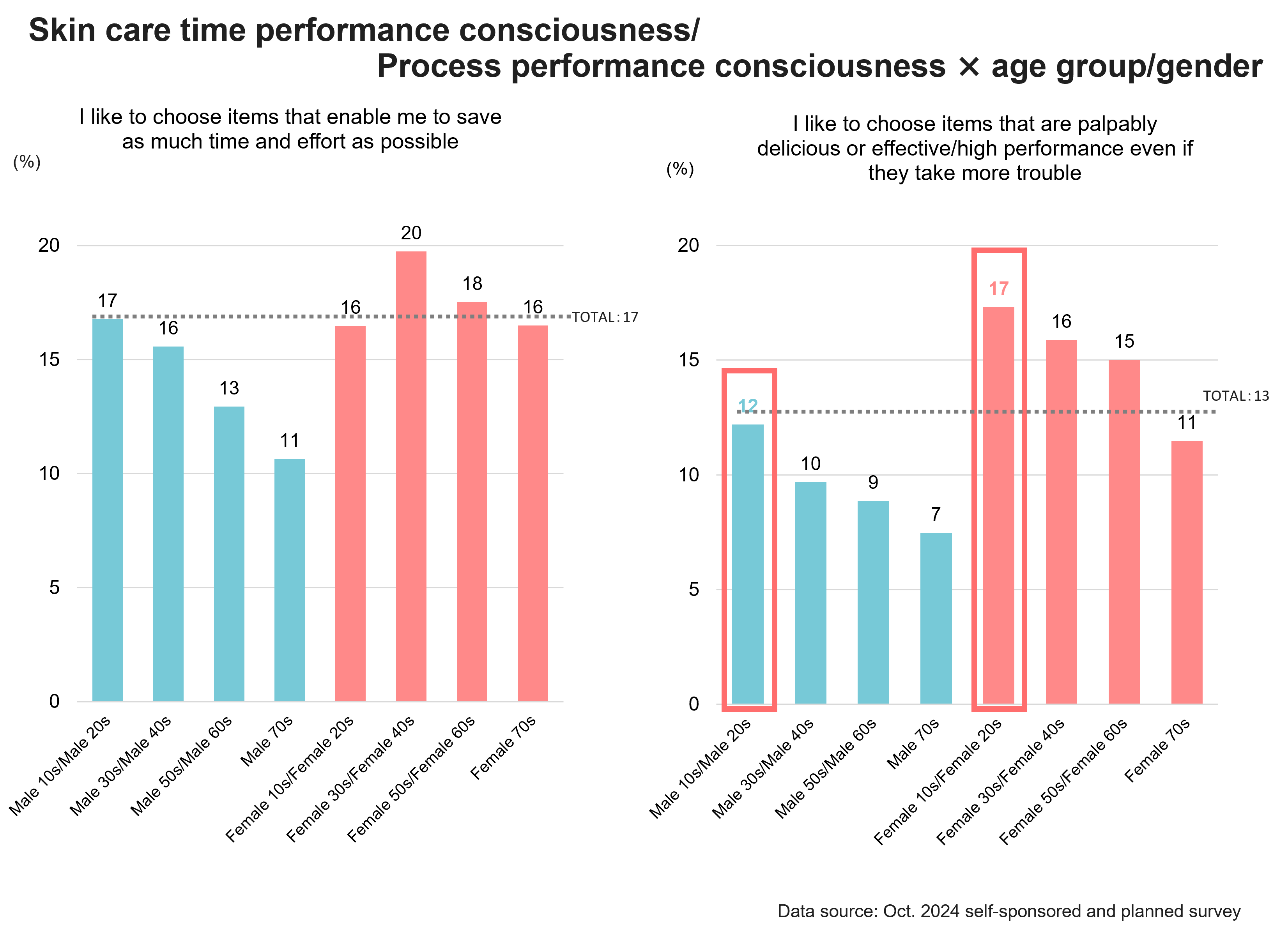
When compared to the results of the time performance consciousness attribute “I like to choose items that enable me to save as much time and effort as possible” by gender and age group, the younger the age group, the higher the time performance consciousness and process performance consciousness for both males and females. In addition, 16% of young females in their teens ~ 20s were time performance conscious and 17% were process performance consciousness, indicating their process performance consciousness is virtually at the same level as their time performance consciousness. As mentioned above, the younger the age group, the higher the tendency for process performance consciousness for both males and females, with 12% of even males in their teens ~ 20s placing importance on process performance. This segment, coupled with men’s outlook on beauty, seem to have an uncompromising approach to choosing products. Let’s examine this in detail in the next part of this article.
Fig.3
3. The Impact of Process-Performance Consciousness on Shopping Behavior
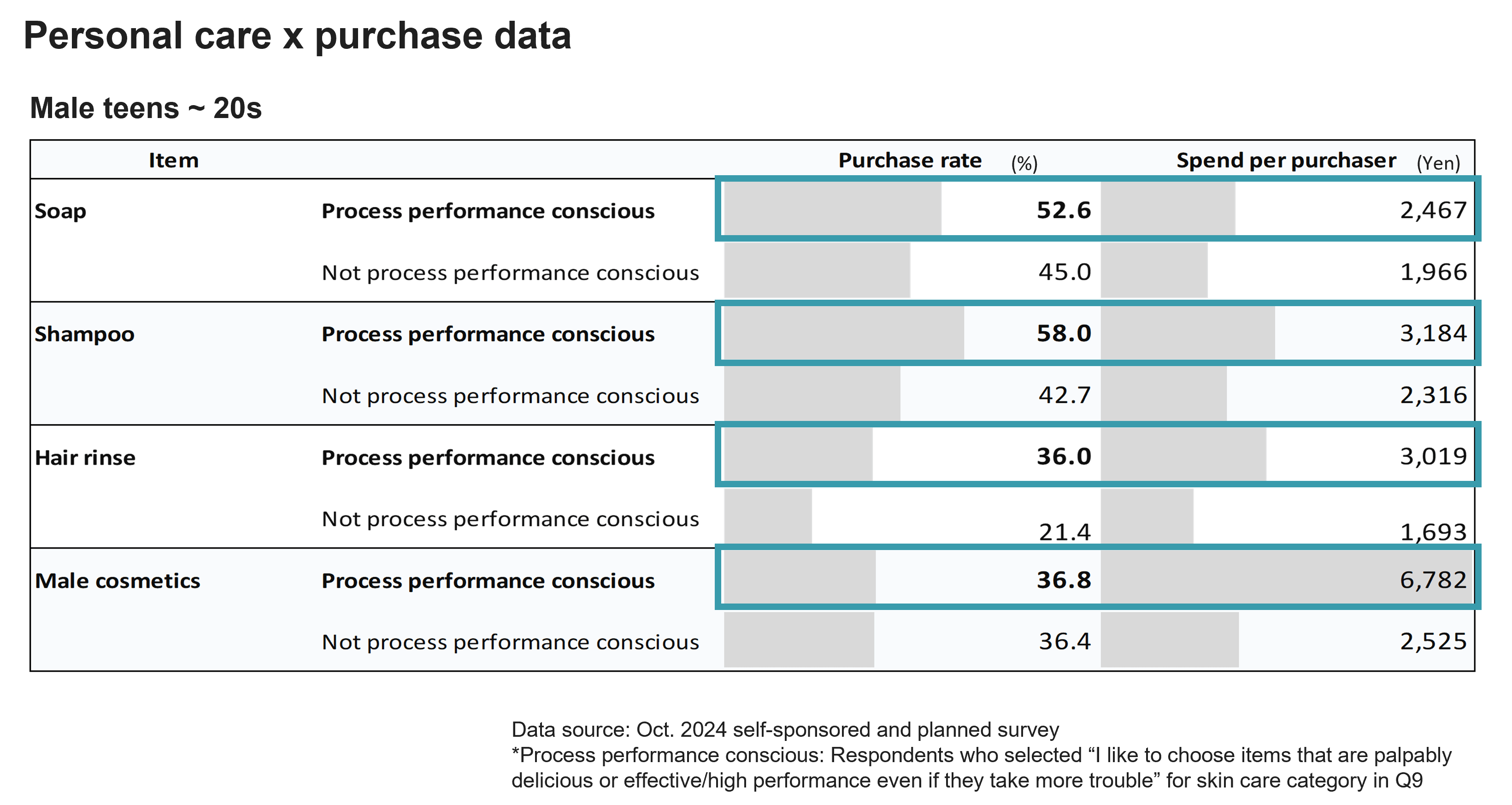
So how does process performance consciousness impact shopping behavior? Upon comparing shopping data for personal care items such as skincare and haircare, categories in which there is a high tendency to place importance on process performance consciousness for males in their teens ~ 20s based on whether they are process performance conscious or not, it is apparent those who are process performance conscious have higher purchase rates and higher purchase spends for each item.
Fig.4
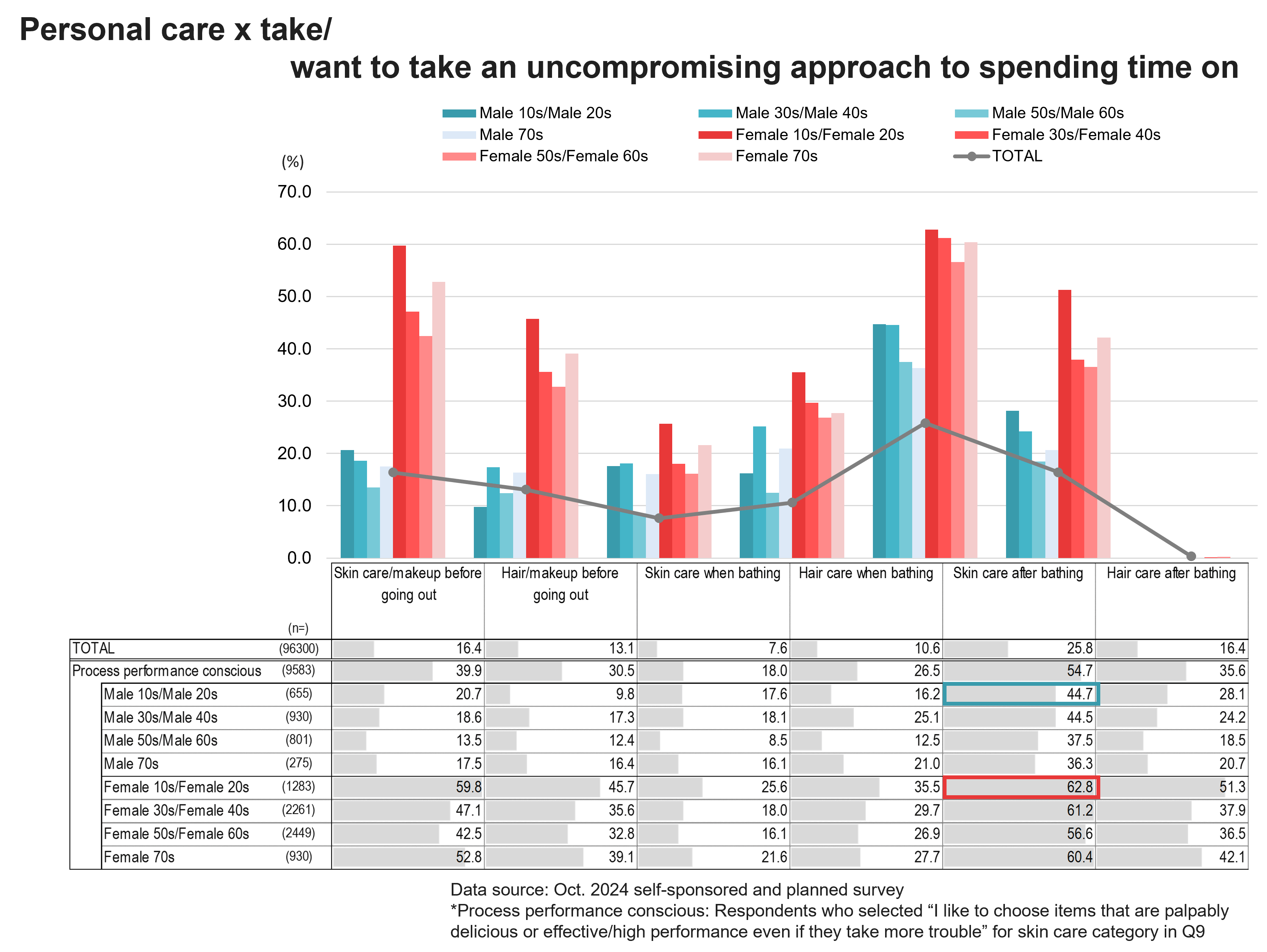
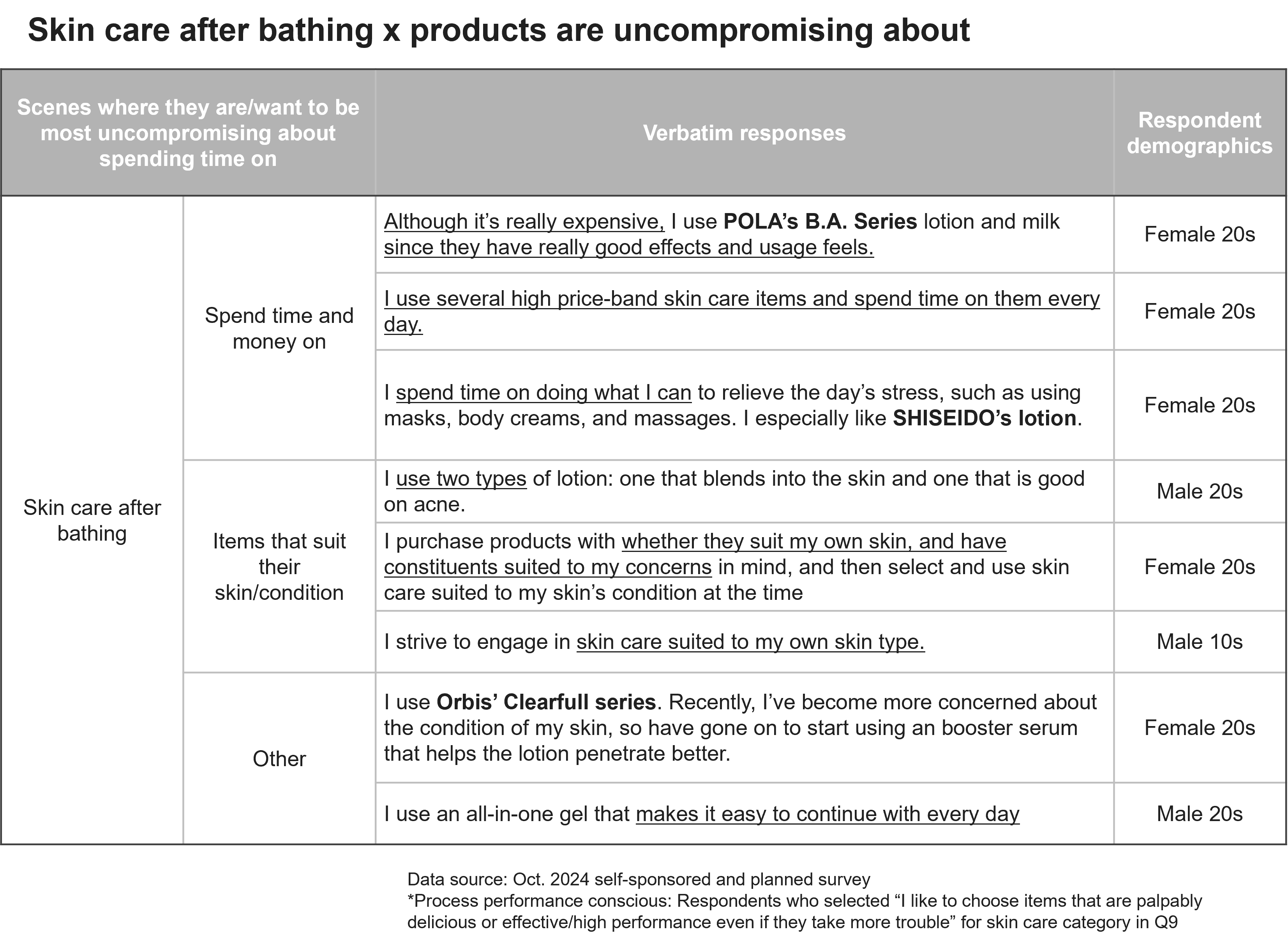
Next, we focused in on scenes in which consumers actually engage in personal care, and asked process performance conscious males and females what they “take/want to take an uncompromising approach to spending time on”, and discovered they had a particularly strong desire to want to take an uncompromising approach to their “skincare after bathing” (Fig.5). Moreover, this was marked among young process performance conscious people in their teens ~ 20s, who upon being asked what they specifically wanted to be uncompromising about, gave responses like “I choose items with good effects and usage feels, even though they are very expensive” and “I purchase items that suit my skin type with the constituents suited to my concerns in mind”, indicating they are not merely spending time and money on “skincare after bathing”, but also place importance on a variety of areas they are uncompromising about, such as whether it suits them/they can continue with it or not (Fig.6).
Fig.5
Fig.6
4. Process-performance consciousness in dietary habits and its impact on shopping behavior
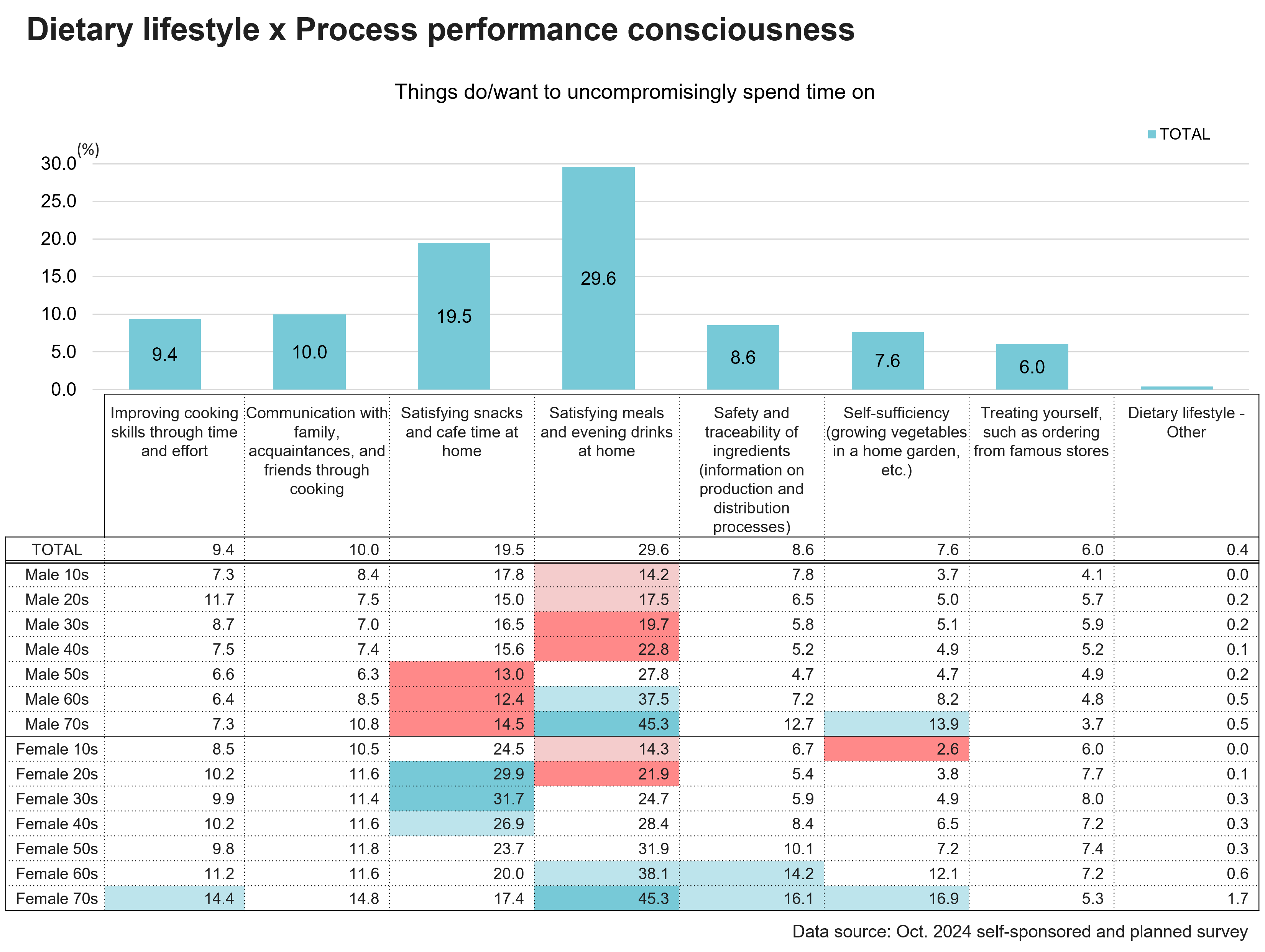
We next examined how process performance consciousness regarding food differs by age and gender. Fig.7 is a graph depicting the results of what people specifically are uncompromising about spending/wanting to spend time on in terms of their daily lives (dietary lifestyles). “Having meals/alcohol of an evening at home” rated highly at 29.6% among the total, while among females in their 20s ~ 40s, “snacks and café time at home” are clearly things they spend/want to spend time on.
Fig.7
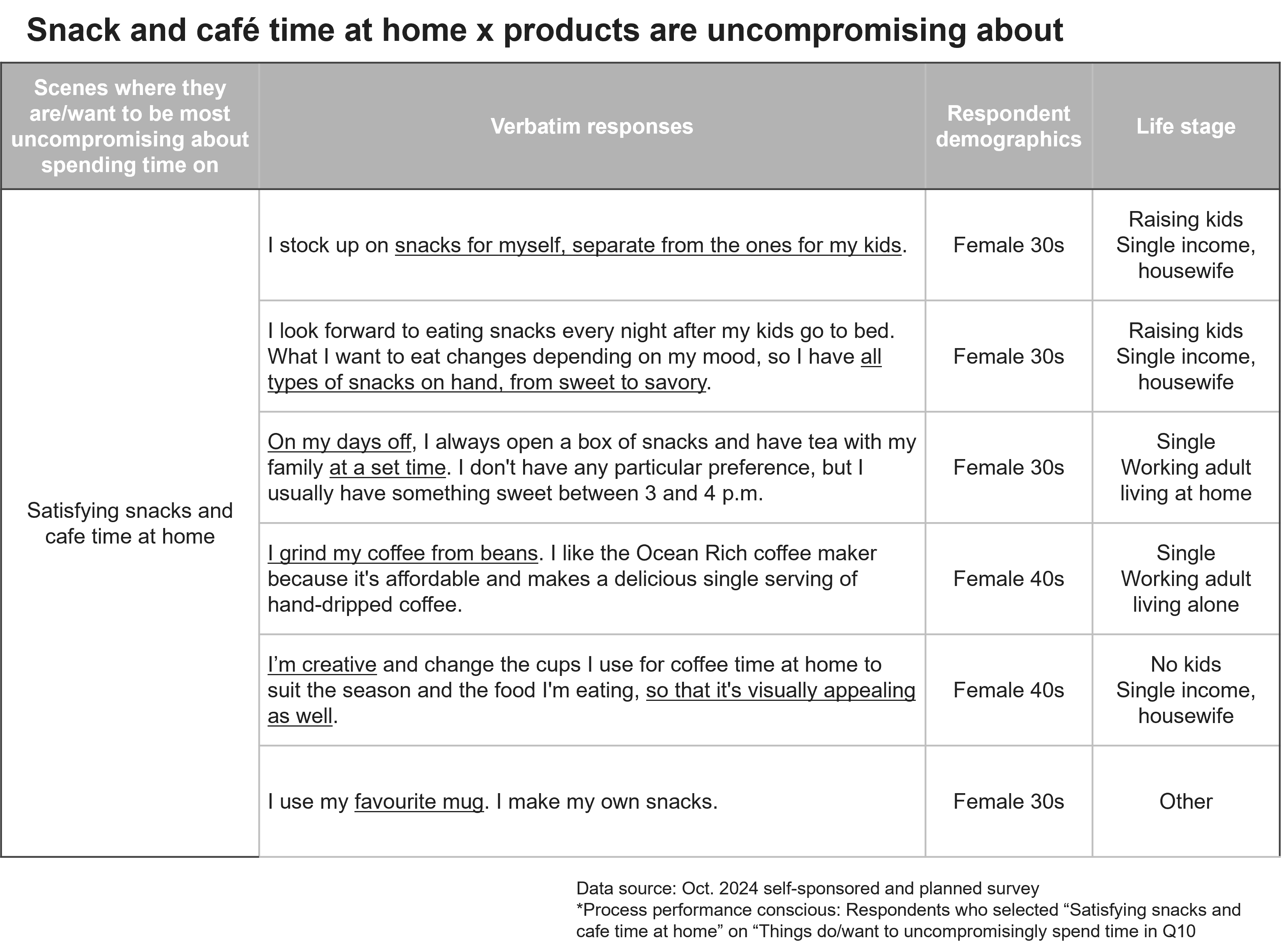
Let’s take a closer look at females in their 30s ~ 40s, who are particularly likely to “spend/want to spend the most time” on “snack/café time.” We asked females in their 30s ~ 40s about what they are specifically uncompromising about (Fig.8). While some are uncompromising about the type of confectionary they buy due to being of a child-rearing age such as “confectionary different from those for my children” and “having all kinds at hand to suit my mood”, others are uncompromising about factors such as “always having time to eat snacks”, “drip coffee” and “tableware”, so tendencies are difficult to define from the data. It is clear there are a variety of factors they are uncompromising about akin to the personal care we examined earlier.
Fig.8
5. Conclusion
In this article, we have reported on the state of process performance consciousness, where consumers enjoy the process, and its relationship to shopping behavior. With personal care in particular where consumers place a relatively strong focus on process performance, it is apparent it is a factor that boosts purchases, and that it is a factor where it is focused upon as much as time performance especially among young people. While the terms time performance and cost performance have become widespread, and many consumers are now conscious of them, it also appears that there are things and situations consumers are even more uncompromising about than saving time and cost. Understanding these gradations in consumption should lead to a greater understanding of the market.
The analysis in this article was based on INTAGE’s SCI (Nationwide Consumer Panel Survey). SCI clarifies the outlooks of your brand’s users, including whether your brands are being bought by consumers who are process performance conscious, and what sorts of people your brand’s target could be. Please do not hesitate to contact us if you are interested.
Reproduction and Quotation
◆This report is copyrighted by INTAGE Inc. Please check the following prohibitions and precautions, and specify the source when reproducing or quoting this report. “Source: INTAGE “Knowledge Gallery” article published MM/DD/YYYY article”
◆The following are prohibited: ・Alteration of this article in full or in part ・Sale or publication of this article in full or in part ・Uses that are against public order and morality, and uses connected with illegal activities ・Reproducing or quoting panel data* for the purpose of advertising or promoting companies, products, or services *Panel data include: SRI+, SCI, SLI, Kitchen Diary, Car-kit, MAT-kit, Media Gauge, i-SSP, etc.
◆Other precautions: ・INTAGE Inc. shall not be liable for any trouble, loss, or damage caused by the use of this report ・These usage rules do not restrict the use of quotations or other uses permitted under the Copyright Act of Japan
◆For inquiries about reproduction and quotation, click here